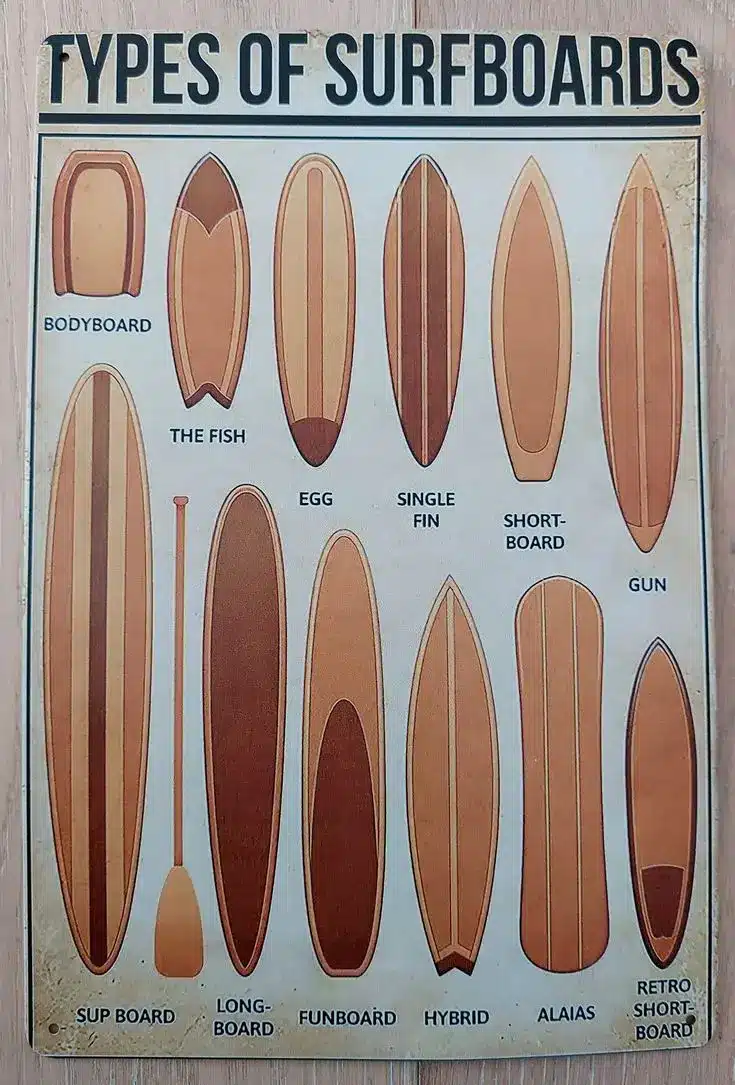

Getting the wrong surfboard size is the single biggest reason beginners quit, intermediate surfers plateau, and even experienced riders stop having fun in the water. A 150 lb beginner needs roughly 68 liters of foam under their feet — yet most first-time buyers walk out with something half that. This complete surfboard size chart guide covers every board type: shortboards, fish, funboards, longboards, and soft tops. Whether you’re buying your first board or sizing down toward a performance shortboard, the tables, volume formulas, and skill-level breakdowns below will get you to the right answer fast — no guesswork required.
Worth Knowing
- Volume beats length. Volume (in liters) is the single most important number when choosing a surfboard — two boards can be the same length but feel completely different if volume differs.
- Use the Guild Factor. Multiply your body weight in kg by 1.0 (beginner), 0.55 (intermediate), or 0.38 (advanced) to get your target volume in liters instantly.
- Bigger is almost always better to start. The most common regret in surfboard buying is going too small, too soon. Stay on your current board until you’re catching waves consistently and riding to the end.
- Epoxy boards float more efficiently. EPS/epoxy construction provides roughly 2–3L more float than traditional PU, so you can subtract that from your target volume when shopping epoxy shapes.
Quick Surfboard Size Guide
- Best board for beginners: Soft-top foamie, 8’0″–9’6″
- Best board for intermediates: Funboard / mid-length, 6’6″–8’6″
- Best board for advanced: Shortboard or fish, 5’6″–6’6″
- Key metric: Volume in liters (not just length)
- Beginner volume rule: Body weight (kg) = target liters
- Board types covered: Shortboard, fish, funboard, longboard, kids
- Sizing down: Only when catching most waves & riding to end
- Kids: Always err larger; soft-tops recommended under 14
Find Your Ideal Board in 30 Seconds
Not sure where to start? Enter your weight, height, and skill level below — the calculator will give you a personalized volume target and board recommendation instantly.
🏄 Surfboard Finder
Find the perfect surfboard for your style
How to Read a Surfboard’s Dimensions
Before any chart makes sense, you need to understand what the numbers on a surfboard actually mean. Walk into any surf shop and you’ll see something like this printed on the stringer or tail pad:
6’2″ × 21½” × 2¾” — 41.9L
That breaks down as: 6 feet 2 inches long, 21.5 inches wide, 2.75 inches thick, with a total volume of 41.9 liters. Length is the most visible number, but width and thickness together determine how much float and stability you actually feel. Volume — the single number in liters — combines all three into one meaningful figure. Two boards can be the same length but feel completely different if one is significantly wider or thicker.
The Guild Factor: The Volume Formula Every Surfer Should Know
Former pro surfer John Whitney Guild popularized a simple formula that’s now used industry-wide. It links your body weight directly to the volume your board needs to carry you effectively. The formula is:
Beginner Guild Factor: 1.0 | Intermediate: 0.5–0.6 | Advanced: 0.35–0.4 | Pro: 0.28–0.32
Example: A 75 kg intermediate surfer → 75 × 0.55 = ~41 liters
One important nuance: epoxy/EPS boards float about 2–3 liters more efficiently than traditional polyurethane (PU) boards, so you can subtract 2–3L from your target volume if you’re going epoxy. Want to skip the math? Use this surfboard volume calculator to get your personalized number instantly.
Surfboard Volume Chart by Skill Level & Weight
This is the master reference table. Find your weight, then cross-reference your skill level to get the target volume range you should be shopping for — regardless of board type.
| Surfer Weight | Beginner (100%) | Beginner-Inter (70%) | Intermediate (55%) | Advanced (38%) | Pro/Expert (30%) |
|---|---|---|---|---|---|
| 100 lbs / 45 kg | 45L | 32L | 25L | 17L | 14L |
| 120 lbs / 54 kg | 54L | 38L | 30L | 21L | 16L |
| 140 lbs / 64 kg | 64L | 45L | 35L | 24L | 19L |
| 155 lbs / 70 kg | 70L | 49L | 38L | 27L | 21L |
| 170 lbs / 77 kg | 77L | 54L | 42L | 29L | 23L |
| 185 lbs / 84 kg | 84L | 59L | 46L | 32L | 25L |
| 200 lbs / 91 kg | 91L | 64L | 50L | 35L | 27L |
| 220 lbs / 100 kg | 100L | 70L | 55L | 38L | 30L |
| 240 lbs / 109 kg | 109L | 76L | 60L | 41L | 33L |
Note on adjustments: Add 3–5L if you surf fewer than once per week. Add 2–3L if you’re over 45 or carrying a previous injury. Subtract 2–3L for epoxy/EPS construction. Add 2–3L if you mostly surf weak, mushy beach breaks.
Shortboard Size Chart
Shortboards are high-performance boards typically between 5’6″ and 6’6″ (1.68–1.98 m), designed for powerful, vertical surfing in overhead-and-up conditions. They demand good wave-reading skills, strong paddling, and a solid pop-up. They are not beginner boards — even intermediates often rush to them too soon. The chart below is calibrated for intermediate-to-advanced surfers who surf at least 2–3 times per week.
| Surfer Weight | Intermediate Length | Advanced Length | Typical Width | Typical Thickness | Volume Range |
|---|---|---|---|---|---|
| 100–120 lbs / 45–54 kg | 5’8″–5’10” (1.73–1.78 m) | 5’6″–5’8″ (1.68–1.73 m) | 18″–19.5″ | 2″–2.25″ | 22–28L |
| 130–150 lbs / 59–68 kg | 5’10″–6’0″ (1.78–1.83 m) | 5’8″–5’10” (1.73–1.78 m) | 18.5″–20″ | 2.25″–2.5″ | 26–32L |
| 155–170 lbs / 70–77 kg | 6’0″–6’2″ (1.83–1.88 m) | 5’10″–6’0″ (1.78–1.83 m) | 19″–20.5″ | 2.4″–2.6″ | 30–36L |
| 175–190 lbs / 79–86 kg | 6’2″–6’4″ (1.88–1.93 m) | 6’0″–6’2″ (1.83–1.88 m) | 19.5″–21″ | 2.5″–2.75″ | 34–40L |
| 200–220 lbs / 91–100 kg | 6’4″–6’6″ (1.93–1.98 m) | 6’2″–6’4″ (1.88–1.93 m) | 20″–21.5″ | 2.6″–2.875″ | 38–46L |
Step-up shortboard note: Surfing large waves — say, 6–10 ft (1.8–3 m) and above — often calls for a “step-up,” which is 2–4 inches longer than your regular shortboard with a pulled-in tail and more rocker. If you’ve ever watched surfers tackle some of the biggest waves in the world, you’ll notice the boards get longer, narrower, and considerably thicker — those are guns, a specialized category beyond standard shortboards.
Fish Surfboard Size Chart
The fish is a retro-inspired shape with a wide nose, fuller rails, flat rocker, and a swallow tail. Because of their extra width and thickness, fish boards are typically ridden 2–6 inches shorter than a standard shortboard of equivalent volume. They excel in small-to-medium, punchy waves (1–4 ft / 0.3–1.2 m) and are a favorite for surfers who want speed and fun without the commitment of performance shortboarding. Fish boards work well for confident beginners and intermediate surfers — but don’t confuse them with beginner boards; their flat rocker means they’re fast but less forgiving on steeper waves.
| Surfer Weight | Skill Level | Fish Length | Typical Width | Typical Thickness | Volume |
|---|---|---|---|---|---|
| 100–120 lbs / 45–54 kg | Beginner-Inter | 5’8″–5’10” (1.73–1.78 m) | 19.5″–20.5″ | 2.3″–2.5″ | 28–34L |
| 130–150 lbs / 59–68 kg | Beginner-Inter | 5’10″–6’2″ (1.78–1.88 m) | 20″–21″ | 2.4″–2.6″ | 34–42L |
| 155–170 lbs / 70–77 kg | Intermediate | 6’0″–6’4″ (1.83–1.93 m) | 20.5″–21.5″ | 2.5″–2.75″ | 38–48L |
| 175–190 lbs / 79–86 kg | Intermediate | 6’2″–6’6″ (1.88–1.98 m) | 21″–22″ | 2.6″–2.875″ | 44–54L |
| 200–220 lbs / 91–100 kg | Inter–Advanced | 6’4″–6’8″ (1.93–2.03 m) | 21.5″–22.5″ | 2.75″–3″ | 50–60L |
If you’re a beginner-intermediate considering a fish as your first hard board off a foamie, add 2–4 inches to the lengths listed above and prioritize the higher end of the volume range.
Funboard & Mid-Length Size Chart
Funboards (sometimes called mini-mals or mid-lengths) sit in the 6’6″–8’6″ (1.98–2.59 m) range. They’re the most versatile category in surfing — enough volume to catch waves easily, enough maneuverability to practice turns. Mid-lengths in particular have exploded in popularity over the last five years among surfers who just want to have the most fun possible across the widest range of conditions. If you surf 2–3 days a week in small-to-medium beach break, a mid-length is arguably the best all-around investment you can make.
| Surfer Weight | Recommended Length | Typical Width | Typical Thickness | Volume | Best For |
|---|---|---|---|---|---|
| 100–120 lbs / 45–54 kg | 6’6″–7’2″ (1.98–2.18 m) | 20.5″–21.5″ | 2.5″–2.75″ | 38–48L | Beginner-Inter |
| 130–150 lbs / 59–68 kg | 7’0″–7’6″ (2.13–2.29 m) | 21″–22″ | 2.6″–2.875″ | 46–56L | Beginner–Intermediate |
| 155–170 lbs / 70–77 kg | 7’4″–7’10” (2.24–2.39 m) | 21.5″–22.5″ | 2.75″–3″ | 52–64L | Beginner–Intermediate |
| 175–190 lbs / 79–86 kg | 7’8″–8’2″ (2.34–2.49 m) | 22″–23″ | 2.875″–3.125″ | 58–72L | Beginner–Intermediate |
| 200–220 lbs / 91–100 kg | 8’0″–8’6″ (2.44–2.59 m) | 22.5″–23.5″ | 3″–3.25″ | 66–82L | Beginner–Intermediate |
Longboard Size Chart
Longboards run from 8’6″ to 11’+ (2.59–3.35+ m) and are defined by smooth, flowing surfing — cross-stepping to the nose, hanging five or ten, riding with style over raw performance. Volume ceases to be the primary concern on a longboard because even a “small” longboard at 8’6″ carries far more foam than a shortboard will ever need. The real question when sizing a longboard becomes: how big a board can you physically handle, store, and transport? Use the chart below as an upper-end guide rather than a minimum.
| Surfer Weight | Beginner Length | Intermediate/Advanced Length | Typical Width | Thickness | Volume |
|---|---|---|---|---|---|
| Under 130 lbs / 59 kg | 8’6″–9’0″ (2.59–2.74 m) | 8’6″–9’6″ (2.59–2.90 m) | 22″–23″ | 2.75″–3″ | 58–75L |
| 130–155 lbs / 59–70 kg | 9’0″–9’6″ (2.74–2.90 m) | 8’8″–9’2″ (2.64–2.79 m) | 22.5″–23.5″ | 2.875″–3.1″ | 68–85L |
| 155–175 lbs / 70–79 kg | 9’4″–9’10” (2.84–3.0 m) | 9’0″–9’6″ (2.74–2.90 m) | 23″–24″ | 3″–3.25″ | 76–95L |
| 175–200 lbs / 79–91 kg | 9’8″–10’2″ (2.95–3.10 m) | 9’4″–10’0″ (2.84–3.05 m) | 23.5″–24.5″ | 3.1″–3.4″ | 86–106L |
| 200–230 lbs / 91–104 kg | 10’0″–10’8″ (3.05–3.25 m) | 9’6″–10’2″ (2.90–3.10 m) | 24″–25″ | 3.25″–3.5″ | 95–118L |
Soft-top longboards (“foamies”) add extra float due to their foam construction, so you can often go 4–6 inches shorter than the hard board lengths above and still get equivalent stability. These are the recommended starting point for all beginners.
Kids & Youth Surfboard Size Chart
Children progress through surfboard sizes faster than adults, so always err larger rather than smaller — a kid on a board that’s too big will still surf; a kid on a board that’s too small will struggle and lose interest fast. Soft-top foamies are strongly recommended for all beginners under 14. For safety, every child should have a board with a leash and wear a rash guard or wetsuit to protect against board bumps.
| Age (approx.) | Height | Weight | Recommended Board | Board Length | Volume |
|---|---|---|---|---|---|
| 5–7 years | 3’8″–4’2″ (112–127 cm) | 40–55 lbs / 18–25 kg | Foam / Soft-top | 5’0″–5’6″ (1.52–1.68 m) | 30–38L |
| 8–10 years | 4’2″–4’8″ (127–142 cm) | 55–80 lbs / 25–36 kg | Foam / Soft-top | 5’6″–6’2″ (1.68–1.88 m) | 36–50L |
| 10–12 years | 4’6″–5’0″ (137–152 cm) | 75–100 lbs / 34–45 kg | Foam or entry hard board | 6’2″–7’0″ (1.88–2.13 m) | 40–58L |
| 12–14 years | 5’0″–5’6″ (152–168 cm) | 90–130 lbs / 41–59 kg | Funboard or fish | 6’8″–7’6″ (2.03–2.29 m) | 44–62L |
| 14–16 years | 5’4″–5’10” (163–178 cm) | 115–155 lbs / 52–70 kg | Funboard / shortboard | 6’4″–7’4″ (1.93–2.24 m) | 38–56L |
What Size Surfboard Should a Beginner Get?
The answer is almost always: bigger than you think. The most common beginner mistake is buying a board that flatters the ego but tanks progression. A soft-top foamie between 8’0″ and 9’6″ (2.44–2.90 m) is the single best starting point for almost every adult beginner, regardless of athletic background. These boards have the volume to paddle into waves without exhaustion, the stability to stand and balance, and the soft surface to prevent injury when the inevitable wipeouts happen.
General beginner sizing rule: your first board should be at least 1–3 feet taller than you are. If you’re 5’8″ (1.73 m), start on something in the 8’6″–9’0″ (2.59–2.74 m) range. The goal isn’t to look cool on the beach — it’s to catch as many waves as possible per session, because wave count is the engine of progression.
Is a 7-Foot Surfboard Good for a Beginner?
It depends. A 7-foot funboard with high volume (50L+) can work for lighter beginners under 130 lbs, but for most adults it’s a compromise board — not quite stable enough for real beginners, not quite performance enough for improving intermediates. If you’re tempted by a 7-footer because it fits your car easier or looks more manageable, just know that you’ll likely outgrow the benefits of a longboard before you outgrow the need for its volume. Stick to 8’0″+ for your first 3–6 months.
Foam Board vs. Hard Board: What’s Right for Your First Surfboard?
Soft-top foam boards win for safety and value at the beginner stage. They’re forgiving on your body (and others in the water), durable against dings, and often cheaper than entry-level hard boards. Once you can consistently ride waves to the end, link a top-turn and bottom-turn, and paddle out through waist-to-chest-high whitewater without losing your board — then it’s time to consider a hard funboard or mid-length for your next step.
Size by Height & Weight: Combined Reference Table
This table is for beginner-to-intermediate surfers who want a quick reference combining both height and weight. Use it to find a starting board length — then cross-check with the volume chart above to confirm volume is in the right range for your skill level.
| Surfer Height | Under 130 lbs / 59 kg | 130–160 lbs / 59–73 kg | 160–185 lbs / 73–84 kg | 185–220 lbs / 84–100 kg | 220+ lbs / 100+ kg |
|---|---|---|---|---|---|
| Under 5’4″ (163 cm) | 7’2″–7’10” | 7’8″–8’4″ | 8’2″–8’8″ | 8’6″–9’0″ | 9’0″–9’6″ |
| 5’4″–5’8″ (163–173 cm) | 7’6″–8’2″ | 8’0″–8’6″ | 8’4″–9’0″ | 8’8″–9’4″ | 9’2″–9’10” |
| 5’8″–6’0″ (173–183 cm) | 7’10″–8’6″ | 8’4″–9’0″ | 8’8″–9’4″ | 9’0″–9’8″ | 9’6″–10’2″ |
| 6’0″–6’3″ (183–191 cm) | 8’2″–8’10” | 8’8″–9’4″ | 9’0″–9’8″ | 9’4″–10’0″ | 9’10″–10’6″ |
| Over 6’3″ (191+ cm) | 8’6″–9’2″ | 9’0″–9’8″ | 9’4″–10’0″ | 9’8″–10’4″ | 10’2″–10’10” |
These lengths assume a beginner-to-intermediate level and a foamie or mid-length style board. Intermediate-advanced surfers should reduce these lengths by 1’6″–2’6″ depending on skill and board type.
What Does Surfboard Volume Mean and How Much Do I Need?
Surfboard volume, measured in liters, tells you how much water a board displaces — which directly translates to how much it floats. Higher volume = more buoyancy = easier paddling, faster wave-catching, more stability. Lower volume = less float = faster turns, more sensitivity, but harder to catch waves and stay afloat if your technique isn’t dialed.
Volume isn’t everything, though. Two boards can have identical volume but completely different ride characteristics based on where that volume is distributed. A high-volume board with thick rails and a full nose will feel much more stable and forgiving than a board of the same volume with thin rails and a pulled-in outline. That’s why understanding terms like rocker, concave, and tail shape matters alongside volume — if you’re still getting familiar with these concepts, our guide to surfing terms explained covers all the key vocabulary you’ll encounter when shopping for boards.
Volume Formula: Quick Reference
Intermediate: Body weight (lbs) × 0.28–0.35 = Minimum volume in liters
Advanced: Body weight (lbs) × 0.20–0.25 = Minimum volume in liters
Example: 170 lb intermediate → 170 × 0.30 = 51 liters
For metric users: a 70 kg beginner needs approximately 70L; the same 70 kg intermediate needs approximately 38–42L. When in doubt, go slightly over your calculated volume — a board with 3–5L more than you need is far easier to manage than one 3–5L under. The most common regret in surfboard buying is going too small, too soon.
How Do I Know When to Size Down My Surfboard?
This is one of the most misunderstood questions in surfing. Ego pushes people toward smaller boards before their skills support it, which stalls progression and makes the water frustrating instead of fun. Two honest tests will tell you whether you’re actually ready to go smaller.
Test 1 — Wave Count: Are you catching the majority of waves you paddle for in a session? If you’re sitting in the lineup and missing wave after wave, your current board isn’t too big — you need to keep riding it. Only when you’re consistently catching waves and getting long rides should you even consider downsizing.
Test 2 — Down the Line: Are you riding all the way to the end of the wave and generating enough speed that you actually need to turn to stay in the pocket? A turn is a functional maneuver to return you to the power source of the wave. If you’re not generating the speed and distance that makes turns necessary, a smaller, harder-to-paddle board won’t help you develop that skill — it’ll just reduce your wave count further.
When you do size down, do it gradually. Going from a 9-foot longboard straight to a 6’2″ shortboard is one of the most common and counterproductive moves in surfing. Instead, step down in 6-inch to 1-foot increments, spending several months on each transition board until you’re confident and catching waves consistently. Below 6’0″, reduce in 1-inch or 1-liter increments — the smaller the board, the more dramatic small changes feel.
Surfboard Types Explained: Which One Is Right for You?
Shortboards Advanced
Typically 5’6″–6’6″ (1.68–1.98 m) with low volume, high rocker, and narrow outline. Built for high-performance surfing: powerful turns, aerial maneuvers, and critical late drops. Require strong paddling fitness and excellent wave-reading ability. Not recommended until you can consistently ride and turn in head-high surf.
Best For: Surfers who surf 3+ times per week in punchy, quality beach break or reef break.
Fish Intermediate
Typically 5’4″–6’4″ (1.63–1.93 m) with a wide nose, flat rocker, swallow tail, and twin or quad fin setup. Loves small, weak, mushy surf where shortboards feel sluggish. The extra width gives surprising paddle power for their length. Fun, fast, and loose — but not ideal in steep, heavy waves.
Best For: Small-to-medium (1–4 ft / 0.3–1.2 m) beach break, gutless point breaks, and intermediate surfers wanting more fun on small days.
Funboard / Mid-Length Beginner–Intermediate
Between 6’6″ and 8’6″ (1.98–2.59 m). The mid-length in particular has become the modern favorite for surfers who want to maximize fun without committing to longboarding. Wide enough to paddle well, short enough to fit in the car, and versatile across a range of wave sizes. Mid-lengths typically use a thruster or 2+1 fin setup.
Best For: Anyone who surfs 1–3 times per week in mixed conditions and wants one board that works everywhere.
Longboard All Levels
8’6″ and longer (2.59 m+). Defined by smooth, gliding surf — cross-stepping, nose-riding, hanging ten. Longboarding is a distinct style of surfing with its own culture and technique. They also happen to be the easiest boards to paddle and the best wave-catchers in small surf, which is why they’re recommended for beginners and beloved by experienced surfers who just want flow.
Best For: Beginners learning to surf, experienced surfers who love style and nose-riding, small-wave days when shortboards won’t perform.
Foamie (Soft Top) Beginner
Foam-constructed boards available in lengths from 5’0″ to 10’+ (1.52–3.05+ m). The EVA foam deck and rubber fin system make them significantly safer than hard boards — both for you and for other people in the water. Modern foamies from brands like Wavestorm, Softech, and Catch Surf ride surprisingly well and are no longer seen as toys. They’re the smartest first board for the vast majority of beginners.
Best For: All beginners, kids, surf schools, and experienced surfers who want a fun, low-stakes session without worrying about dings.
5 Common Surfboard Sizing Mistakes (And How to Avoid Them)
- Going Too Small Too Soon. The most universal mistake. A board that’s under-volumed for your level means fewer waves caught, slower skill development, and more frustration. Bigger boards make you better, faster — even if the ego wants otherwise. The rule of thumb: stay on your current board until you’re catching waves easily and riding them with control, not until you think you “deserve” a smaller one.
- Ignoring Volume, Chasing Length. Two boards that are both 6’4″ can have dramatically different volumes — one might be 38L, the other 46L — and feel completely different in the water. Always look at the volume spec alongside length. A board that’s the right length but wrong volume will disappoint.
- Buying for Aspirational Conditions, Not Real Ones. Surfers who mostly ride 2–3 ft (0.6–0.9 m) beach break shouldn’t buy a board designed for overhead beach break. Choose a board for the waves you actually surf 80% of the time, not the waves you dream about. You can always borrow or rent a step-up for those rare big swells.
- Not Accounting for Surf Frequency. Someone who surfs twice a week has far stronger paddling muscles and better water sense than someone who surfs twice a month — even if they’re the same weight and “skill level.” Less frequent surfers should add 3–5L to their target volume to compensate for the lack of consistent conditioning.
- Skipping the Demo Before You Buy. Many surf shops and surf camps offer board demos or rentals. Before spending $500–$1,000+ on a new board, try a similar shape and volume in the water. Fifteen minutes on a board in your local break tells you more than any size chart — including this one.
Recommended Gear Checklist
- Surfboard matched to your volume target (use the charts above)
- Leash (match length to board length)
- Fins (check your box system: FCS, Futures, or single)
- Surf wax (warm or cold water formula depending on your destination)
- Surf watch / tide tracker
- Board bag (essential for travel and protecting your investment)
- Reef-safe sunscreen
- Rash guard or wetsuit (appropriate thickness for local water temps)
FAQs: Surfboard Size Chart
What size surfboard do I need for my height and weight?
Both matter, but weight is the more important factor because it directly determines how much volume (float) you need. As a starting point, beginners should target a board volume in liters equal to 100% of their body weight in kilograms — so a 70 kg beginner needs approximately a 70-liter board. Then use height to guide length: your board should generally be 1–3 feet taller than you as a beginner. Cross-reference both with the combined height/weight table above for your specific starting point.
Is a 6-foot surfboard too small for a beginner?
Yes, for the vast majority of adult beginners, a 6-foot board is far too small. These boards have low volume, are difficult to paddle, unstable to stand on, and make catching waves extremely challenging without excellent technique. A 6-foot board is appropriate for lighter, athletic surfers at the intermediate-to-advanced level who surf regularly. Beginners should start on a soft-top or funboard in the 8’0″–9’6″ range.
How do I choose the right surfboard as a beginner?
Start with volume first: calculate 100% of your body weight in kg as your target volume in liters. Then look at soft-top foamies or foam-core longboards in that volume range. Don’t let style or aesthetics drive the decision — prioritize stability and paddle power above all else. If possible, rent or borrow several board types before buying. A knowledgeable surf shop or coach will save you from the most common beginner mistake: going too small.
What surfboard volume do I need?
Volume depends primarily on your body weight and skill level. Use the Guild Factor formula as a guide: multiply your body weight in kg by 1.0 (beginner), 0.55 (intermediate), or 0.38 (advanced) to get your target volume in liters. Adjust upward if you surf infrequently, are over 45, or surf mainly weak, mushy waves. Adjust downward if your board is epoxy/EPS construction (which floats 2–3L more efficiently than PU). For a quick personalized result, use an online surfboard volume calculator.
How do I know when to size down my surfboard?
You’re ready to size down when two conditions are consistently met: you’re catching most of the waves you paddle for in a session, and you’re riding them far enough down the line that you genuinely need to turn to stay in the power pocket of the wave. If either of those isn’t happening yet, stay on your current board. When you do downsize, do it in 6-inch to 1-foot increments, not giant leaps — and give each new board several months before jumping down again.