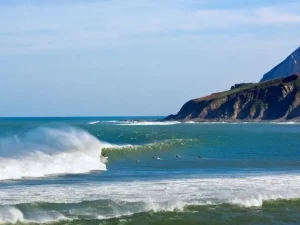

Standing on Santa Catalina’s volcanic point watching perfect right-handers peel for 200 metres with only a handful of surfers out, you understand why Panama is still Central America’s best-kept surf secret. While Costa Rica soaks up the spotlight, this thin strip between two oceans offers something rare: quality waves on both a Pacific and a Caribbean coast, breaking in opposite seasons. When the Pacific fires from April to November on Southern Hemisphere swells, the Caribbean rests; then December to March, Bocas del Toro’s reefs wake up. That means year-round surf if you know where to go, plus the US dollar as currency, long visa-free stays, and a fraction of Costa Rica’s crowds. Here’s the whole country, coast by coast.
Quick surf guide to Panama
- Best season: Pacific Apr to Nov, Caribbean (Bocas) Dec to Mar
- Best for beginners: Playa Venao, El Estero, Old Man’s
- Best for advanced: Santa Catalina (La Punta), Silverbacks
- Main wave types: Pacific point and beach breaks, Caribbean reef breaks
- Water temp: 27 to 29°C year-round, boardshorts only, no wetsuit
- Airports: Panama City (PTY), plus Bocas (BOC) and David (DAV)
- Budget: $50 to 150 a day, and Panama runs on the US dollar
Where to surf in Panama
Panama’s surf splits cleanly between the Pacific coast in the south and west, and the Caribbean islands of Bocas del Toro in the north. Tap a marker to preview a spot, then click its name to jump to it below.
The Pacific coast (April to November)
Remote points and developing beach towns that catch the dominant S and SW swells, with the country’s best wave and its friendliest learner beaches.
Santa Catalina (La Punta)
Panama’s crown jewel and arguably the best point break in Central America. La Punta peels over volcanic reef for 200 metres or more, hollow off the drop and mellowing to a workable wall, and it’s remarkably consistent (roughly 80% of the wet season). The short left is a quick drop, but the right is the money wave. See my full guide to surfing in Santa Catalina. There’s also the hollow left of nearby Punta Roca and the punchier Punta Brava for the experienced.
El Estero (Santa Catalina)
The forgiving beach break just around the headland from La Punta, and where Santa Catalina’s surf schools teach. Soft, sandy peaks make it the ideal place to find your feet before graduating to the point.
Playa Venao
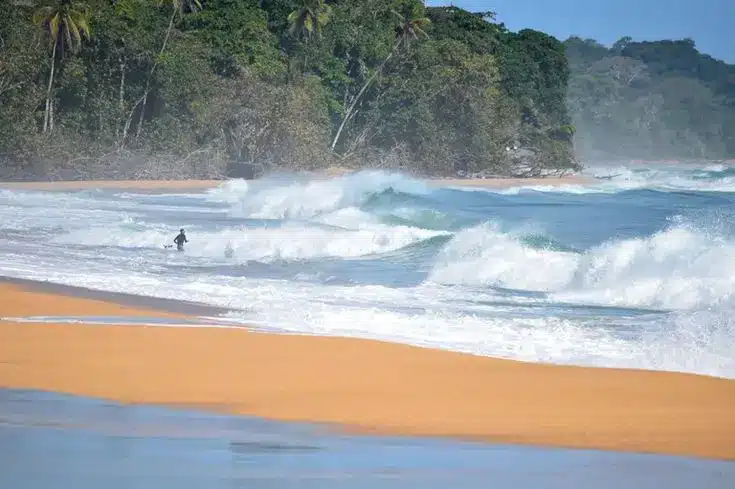
Panama’s best all-round beach and its most popular surf town. A 1.5 mile crescent of soft black sand that holds swell beautifully: mellow corners for beginners, a punchy, occasionally hollow centre for intermediates and up. Very consistent, with schools and camps steps from the sand, which makes it the easiest base for a first Panama trip. See my full guide to surfing Playa Venao.
Playa Cambutal
The lesser-known of the Azuero surf towns, an off-the-beaten-path alternative to Venao with a rocky coastline that forms defined peaks and works best on bigger swells. Quiet, authentic and beautifully undeveloped.
El Palmar
The closest quality surf to Panama City, which makes it the capital’s weekend spot: busy on Saturdays and Sundays, empty midweek. Three distinct breaks (Frente Palmar, Punta Palmar and Hawaiisito) offer variety for all levels.
The Caribbean: Bocas del Toro (December to March)
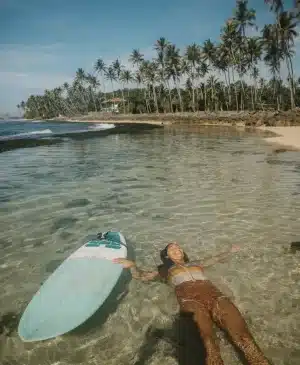
A palm-fringed archipelago of glass-clear water and reef breaks that fire when winter storms off Colombia send swell across 400 miles of open sea. A second, smaller season runs June to August.
Bluff Beach (Isla Colon)
The main beach break on Isla Colon, powerful and hollow with strong currents, so it wants solid skills. Nearby Paunch and Dumpers add reef options along the same coast, all within an easy bike or taxi ride of Bocas Town.
Carenero Point
The most consistent quality wave in Bocas, a long, workable left off Isla Carenero that handles good-sized swells and stays fun rather than terrifying. A five minute water taxi from town makes it the easy daily go-to.
Old Man’s
The go-to beginner spot in Bocas, a mellow, predictable left on Isla Carenero in a calm setting. The forgiving shape makes it a great place to learn how a point break works before stepping up to Carenero Point proper.
Silverbacks (Isla Bastimentos)
The Caribbean’s heaviest wave, a thick, fast, hollow right over shallow reef off Isla Bastimentos that’s been compared to Pipeline and has injured serious surfers. It can reach 15 to 20 ft and draws visiting pros. Strictly experts only.
Wizard Beach (Isla Bastimentos)
A stunning stretch of jungle-backed sand on Isla Bastimentos (near Red Frog Beach) that picks up a fun beach break on the right swell. As much a day out as a surf, reached by boat and a short jungle walk, with the postcard Bocas scenery thrown in.
When to surf in Panama
Panama’s two coasts trade off with the seasons, so there’s almost always somewhere working. The transition months (October to November) can offer waves on both, though neither at full power.
Pacific coast (Santa Catalina, Venao, Cambutal)
Caribbean coast (Bocas del Toro)
Shoulder
Off-season
The Pacific fires April to November on Southern Hemisphere swells, with May to September the most consistent and July to August the biggest. Don’t fear the rainy season: mornings are sunny and glassy, and the afternoon storms clear fast. One critical note: the Pacific has a huge 15 to 18 ft tidal range, so Santa Catalina works mid to high and gets dangerously shallow at low. Bocas runs December to March (peak Dec to Feb), with a smaller June to August window, and its tiny 2 to 3 ft tidal range means you can surf almost any tide.
Surf camps and lessons in Panama
Panama’s camp scene is growing fast and aimed mostly at learners, clustered in Santa Catalina and Playa Venao on the Pacific and around Bocas Town on the Caribbean. Expect roughly $50 to 80 for a group lesson, $15 to 35 a day for board rental, and genuinely good value across the board. Bring cash to remote spots like Santa Catalina, which has no ATM.
Compare surf camps in Panama on BookSurfCamps
What to pack for Panama
Water sits at 27 to 29°C year-round, so no wetsuit, just boardshorts and a rash guard. The essentials:
- Reef booties (essential for the volcanic reef at Santa Catalina and the coral at Bocas)
- Reef-safe SPF 50+ and antibiotic ointment for reef cuts, which infect fast in the tropics
- A surf watch for the big Pacific tides, and US dollars in cash for remote towns
- Learning here? See our best beginner surfboards, and size up with a surfboard size chart or volume calculator
Getting there and around
Everyone arrives via Tocumen International (PTY) in Panama City. From there, Santa Catalina is a five to six hour drive (or fly to David), Playa Venao around five hours, and Bocas del Toro either a one hour flight to BOC or a long bus-and-boat combo. A rental car unlocks the Pacific coast, though hiring in Panama has its quirks (mandatory extra insurance). In Bocas, cheap water taxis zip you between the islands and surf breaks. Planning a bigger trip? See our guide to the best surf destinations in the world.
Frequently asked questions
When is the best time to surf in Panama?
It depends on the coast. The Pacific (Santa Catalina, Playa Venao, Cambutal) is best from April to November, peaking May to September. The Caribbean side, Bocas del Toro, runs December to March with a smaller June to August window. Coast-hop and you can find waves year-round.
Can I surf both coasts in one trip?
Yes, but allow at least 10 to 14 days: five to seven days on one coast, a travel day, then the other. It works best in the transition months (October to November) when both coasts have waves, though neither is at peak consistency. Panama City to Bocas is a one hour flight.
Do you need a wetsuit to surf in Panama?
No. Water temperatures stay 27 to 29°C year-round on both coasts, so boardshorts and a rash guard are all you need. Reef booties, on the other hand, are essential for the volcanic and coral reefs.
What’s better for beginners, the Pacific or the Caribbean?
The Pacific, specifically Playa Venao and El Estero at Santa Catalina: sandy bottoms, multiple schools and mellow, consistent corners. Bocas has beginner options like Old Man’s, but most of its waves break over coral reef, which is less forgiving for learning.
Can I use US dollars in Panama?
Yes. Panama officially uses the US dollar (locally called the balboa), so there’s no exchange, no confusing rates, and cards and ATMs work normally. Bring cash for remote surf towns like Santa Catalina, which has no ATM.
Is Santa Catalina suitable for intermediates?
On its smaller, cleaner days La Punta is a fun, workable wall that a confident intermediate can enjoy, ideally at mid to high tide. When it’s big, or at low tide over the shallow reef, it’s firmly advanced terrain. Beginners should stick to nearby El Estero.
Panama won’t hand you a manicured resort or Bali’s exotic buzz. What it gives you is rarer: quality, uncrowded waves in a place that still feels like discovery. Santa Catalina rivals any Central American point, Playa Venao is one of the most consistent, user-friendly beach breaks anywhere, and Bocas del Toro is a tropical island paradise when the winter swells arrive. Match the coast to the season, pack booties and dollars, and go before the secret is fully out. See you in the line-up.