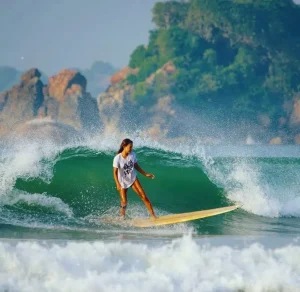
Indonesia isn’t a surf destination so much as the surf destination. Seventeen thousand islands strung right across the Indian Ocean swell, warm water every month of the year, and more world-class reef than the rest of Asia combined: this is where the left-hand barrel was basically invented. It’s also huge and wildly varied, from beginner beach breaks you can surf on day one to shallow-reef bombs that will humble anyone. The trick is matching the island to your level and your season. Here’s the whole archipelago, region by region, plus when to go and where to stay. For the bigger picture, it sits right near the top of our guide to the world’s best places to surf.
Find your perfect surf spot in Indonesia
Answer 3 quick questions to find the Indonesian wave that fits you best.
Quick surf guide to Indonesia
- Best season: May to October (dry season) for clean SW groundswell and offshore winds
- Best for beginners: Canggu (Bali), Selong Belanak and Gerupuk (Lombok), Batu Karas (Java)
- Best for advanced: Desert Point, HTs and Macaronis (Mentawai), G-Land, Uluwatu
- Water temp: 27 to 29°C, so boardshorts or a springsuit, no wetsuit
- Main gateway: Bali (Denpasar, DPS), then domestic flights and boats
- Budget: $35 to $60 a day in Bali and Lombok, far more for Mentawai boat charters
Where to surf in Indonesia
There are thousands of islands to get through, so we’ve broken it down region by region. Tap a marker to preview a spot, then click its name to jump straight to it below.
Surfing in Bali
The Island of the Gods packs a lifetime of waves into a few hundred kilometres of reef. The Bukit Peninsula in the south west is the jewel, a run of world-class lefts, while the east and west coasts hold the wet-season and beginner options.
Uluwatu
The wave that put Bali on the map. A long, hollow left that reels along the Bukit reef beneath a clifftop temple, breaking into several sections (the Peak, Racetrack, Outside Corner) that hold size and throw genuine barrels. It handles everything from head-high fun to serious swell, though shallow reef and strong currents mean it rewards experience. Paddle out through the cave and pick your section. See my full guide to surfing Uluwatu.
Padang Padang
When it’s on, Padang is one of the best barrels on the planet: a thick, square left that detonates over dry reef and hosts the Rip Curl Cup. It needs a good-sized swell to break at all, and when it does it’s strictly for experts. On smaller days the inside section (Baby Padang) is a fun, forgiving beginner spot, so the beach earns its keep either way.
Bingin
A photogenic, high-performance left that runs fast and hollow over a shallow reef before drying out on the inside. Rides are short but pure quality, and the tumble of clifftop warungs makes it one of the most enjoyable places on the Bukit to spend a day. Best at mid tide with a bit of size on it.
Balangan
A longer, more forgiving left than its heavier Bukit neighbours, peeling along the reef in workable walls that suit improving surfers on the right tide. It gets busy, but there’s more room to move than at Bingin or Padang. A smart step up before you tackle Uluwatu proper.
Canggu
Bali’s lifestyle and learn-to-surf capital, a string of beach and reef peaks (Batu Bolong, Echo Beach, Berawa) with something for most levels and an ecosystem of surf schools, cafes and coworking spaces around it. It’s crowded and no longer cheap, but the consistency and the scene keep people coming back for months at a time.
Keramas
The east coast’s crown jewel and a WSL Championship Tour venue: a fast, punchy right over black sand and reef that launches airs and the odd barrel. It flips Bali’s usual calendar, firing when the west coast is blown out, and lights up best at dawn. Reef booties are worth having.
Medewi
One of the longest, gentlest left point breaks in Bali, rolling over rounded rocks for rides that go on and on. It’s a longboarder’s dream and a lovely place to log or progress away from the Bukit crush, out in quiet, rural west Bali. Watch your footing on the rocks at the take-off.
The Nusa Islands
A short boat ride off Bali’s south east coast, the Nusa Islands trade traffic and crowds for crystal water and boat-access reefs.
Nusa Lembongan
Playgrounds, Lacerations and Shipwrecks line up off Lembongan’s north coast: punchy reef waves that need a boat or a long paddle, which keeps the crowds honest. The water is glassy and clear, and when Bali is a zoo this is the mellow escape. Shipwrecks is the pick when there’s some size around.
Surfing in Lombok
Bali’s quieter neighbour to the east, with Kuta Lombok as the hub and a bay for every level within a scooter ride, plus one of the world’s best lefts hiding in the far south west.
Gerupuk
A protected bay east of Kuta Lombok holding a handful of reefs. Inside is a forgiving beginner-improver wave (and consequently packed), while Outside and Don-Don serve up bigger, better-shaped rides. A short boat hop from the shore gets you out. This is the go-to while you’re finding your feet on reef.
Selong Belanak
The best pure beginner beach on the island: a horseshoe bay of white sand with soft, rolling whitewater, a row of surf schools and warm, waist-deep water to fall into. If you’re learning to surf in Lombok, you’ll almost certainly start right here. See my full guide to surfing in Selong Belanak.
Mawi
A serious step up: a thick, powerful left (plus a right) that barrels over shallow reef at the end of a rough track through the hills. Strong currents and a heavy lip keep the crowds thinner than the beginner bays. For confident surfers only, and worth checking the tide before you commit.
Ekas
Out on Lombok’s south east corner, Ekas Bay holds Inside Ekas, a cruisy deep-water left ideal for coming off the sand, and Outside Ekas, a steeper A-frame that barrels on bigger swells. It’s a mission to reach, which is exactly why the lineups stay quiet. See my full guide to surfing in Ekas.
Desert Point
Bangko Bangko, better known as Desert Point, is one of the best waves on Earth: a freight-train left that races along a shallow reef into an impossibly long barrel. It’s fickle, shallow and unforgiving, breaking properly only a handful of days a season, but those days are the stuff of legend. Strictly for experts, and worth the pilgrimage if you are one. See my full guide to surfing Desert Point.
Surfing in Sumbawa
The next island east of Lombok opens straight onto the same SW swell channels but sees a fraction of the crowds. Almost everything here is hollow, and often empty.
Lakey Peak
The heart of Sumbawa’s surf scene: a consistent A-frame peak that throws a barreling right (Lakey Pipe) and a longer left, with Periscopes and Nungas nearby to spread the crowd. A cluster of low-key losmen sits right in front of the wave, so you can roll out of bed and paddle straight out. See my full guide to surfing in Lakey Peak.
Scar Reef
A long, walling left on Sumbawa’s west coast that runs fast over a sharp reef, rewarding a strong backhand with big, drawn-out sections. Powerful, consistent and often empty. Bring booties and a spare fin, because the reef here does not forgive.
Super Suck
The name is a warning. When the swell is right, Super Suck is a dredging, mechanical left barrel over dry reef, one of Indonesia’s heaviest tubes. Short window, shallow reef, huge reward. Not a place to be learning, but a bucket-list tube for those who can handle it.
The Mentawai Islands
A boat ride off west Sumatra, the Ments are the closest thing surfing has to a promised land: dozens of world-class reefs in warm, clear water, reached by charter boat or a growing crop of land camps. Peak season is the dry SW-swell window from April to October.
Macaronis
Often called the most fun wave in the world: a short but flawless left that offers a top-turn, a barrel section and a ramp for an air on nearly every wave. It’s forgiving enough for confident intermediates and endlessly rippable for experts, which is why the camp on the point stays booked out well ahead.
HTs (Lance’s Right)
Also known as Lance’s Right, HTs (Hollow Trees) is a machine of a right-hander that spins down the reef at Katiet in near-perfect, spitting barrels. It’s the poster wave of the Mentawais and rightly so, but the reef is shallow and it demands total commitment. One of the best rights on the planet.
Lance’s Left
The mellower counterpart to HTs just across the way: a long, user-friendly left that offers workable walls and the odd cover-up without the life-or-death reef. A favourite of charter boats looking to keep every level on board happy at the same spot.
Rifles
A racy, hollow right that machine-guns down the reef for hundreds of metres when the swell lines up, one of the longest barrels in the Ments. It needs size and a fast board under your feet, and it doesn’t wait for anyone. Elite stuff, and unforgettable when you make one.
Telescopes
A long, wrapping left with fast walls and barrel sections that’s more forgiving than the region’s heaviest reefs, which makes it a charter-boat staple. Plenty of face to work with, and rides that just keep going. A great one to build confidence before you tackle HTs.
Surfing in Sumatra
Beyond the Mentawais, mainland Sumatra and its islands hold a lifetime of empty barrels for those willing to travel. Two names lead the way.
Nias (Lagundri Bay)
Sorake, in Lagundri Bay on the island of Nias, is one of the most perfect right-hand reef waves anywhere: a wrapping, barreling wall that only grows more flawless the bigger it gets. It shot to fame decades ago and remains a bucket-list pilgrimage, with a low-key village strung right along the point. See my full guide to surfing in Nias.
Krui
A frontier region on Sumatra’s south west coast that feels like Lombok before the crowds. Ujung Bocur is a long, hollow left point, Way Jambu (the Sumatran Pipeline) barrels for experts, and the beach breaks along Pantai Krui offer mellow A-frames for everyone else. Miles of coast, barely a soul in the water. See my full guide to surfing in Krui.
Surfing in Java
Indonesia’s most populous island hides its best surf in the wild, jungle-backed south, headlined by one of the greatest waves on the planet.
G-Land (Grajagan)
Grajagan, or G-Land, is a run of long, barreling lefts peeling along a reef inside a jungle national park in far east Java, from the mellower Kongs through the heavy Money Trees and Launching Pads. Regularly rated Indonesia’s single best wave, it’s a proper pilgrimage, usually surfed on a stay at one of the bay’s rustic jungle camps. See my full guide to surfing G-Land.
Batu Karas
A rare Javan beginner haven: a sheltered bay with a soft point break and a mellow beach, tucked into a quiet fishing village. It’s where Jakarta and Bandung come to learn to surf, a world away from the heavy reefs further east. A lovely, low-pressure place to log a few days.
When to surf in Indonesia
Building (April)
Wet season, east coast fires (Nov to Mar)
The dry season (roughly May to October) is when Indonesia does what it’s famous for: clean, powerful SW groundswell and offshore trade winds lighting up the reefs of Bali, Lombok, Sumbawa, the Mentawais and Java. July and August are the biggest and busiest months of the lot.
The wet season (November to March) flips the script. The west-facing reefs go onshore and inconsistent, but Bali’s east coast (Keramas, Nusa Dua, Sanur) comes alive with cleaner conditions and thinner crowds, and the far eastern islands have their own windows. April and October are the sweet-spot shoulders: good swell, fewer people, better prices.
What are the best surf camps in Indonesia?
Indonesia is one of the great surf-camp countries, and where you go depends entirely on your level. Bali and Lombok are packed with beginner-focused schools and progression camps (think daily lessons, video analysis and yoga), while the Mentawais and Sumbawa are the domain of hardcore charter boats and land camps built around scoring barrels. Learn in the west, chase reef in the east.
Lombok in particular has boomed: see our guide to the best surf camps in Lombok for current picks. If you’d rather have boards, coaching and accommodation sorted in one booking, this is a country built for it.
Compare surf camps in Indonesia on BookSurfCamps
What to pack for Indonesia
The water sits at a balmy 27 to 29°C year-round, so leave the wetsuit at home: boardshorts, or a springsuit for dawn patrols, is all you’ll need. Indonesia is all about reef, so this is your packing checklist:
- Reef booties and a solid first-aid kit, because reef cuts are part of the deal here
- A springsuit for dawn patrols (no full wetsuit needed)
- A surf hat and reef-safe SPF for the tropical sun
- A surf watch to track the tides (many reefs are tide-sensitive)
- The right board: see our best beginner surfboards and check your board volume
- A set of fins and a spare, plus a leash you trust
- Your best outfit from your favourite surf brand: see our best surf clothing brands
- A good travel board bag for the flights and boat transfers
Getting to Indonesia
Most trips start in Bali (Denpasar, DPS), the main international gateway, with direct flights from across Asia and Australia and one-stop connections from Europe. From there, domestic flights and fast boats fan out to Lombok, Sumbawa, the Mentawais (via Padang), Nias, Sumba and beyond. A visa on arrival covers most nationalities for 30 days. It’s a vast country, so pick a region rather than trying to see it all in one trip: island-hopping eats up days you could spend surfing. For more warm-water options nearby, see our guide to surfing in Sri Lanka, or the powerful reefs and points of surfing in Australia further south.
Frequently asked questions
When is the best time to surf in Indonesia?
The dry season, roughly May to October, is prime: consistent SW groundswell and offshore trade winds light up the classic reefs of Bali, Lombok, Sumbawa, the Mentawais and Java, with July and August the biggest. April and October are quieter shoulders. In the wet season (November to March) head for Bali’s east coast, like Keramas and Nusa Dua, which fires when the west is blown out.
Is Indonesia good for beginners?
Yes, in the right spots. Canggu in Bali, Selong Belanak and the inside at Gerupuk in Lombok, and Batu Karas in Java are all forgiving, sandy or deep-water waves with plenty of surf schools. Just steer clear of the heavy, shallow reefs (Padang Padang, Desert Point, Super Suck) until you’re surfing reef confidently.
Where should I go for my first surf trip to Indonesia?
Bali (the Bukit plus Canggu) or Kuta Lombok give the most variety and the easiest logistics, with waves for every level within a short scooter or boat ride. Save the Mentawais, Sumbawa and G-Land for when you’re comfortable on shallow reef and looking for world-class barrels.
Do I need a wetsuit in Indonesia?
No. The water sits around 27 to 29°C all year, so boardshorts or a springsuit at most. The useful bit of kit here is a pair of reef booties, not rubber.
How dangerous are the reefs?
Most of Indonesia’s best waves break over shallow, sharp coral, so reef cuts are common. Know the tide before you paddle out, wear booties where it makes sense, carry a first-aid kit, and don’t take on a spot that’s beyond your level. Respect the reef and it’s one of the safest thrills in surfing.
Bali or the Mentawais?
Bali for variety, nightlife, learning and easy access; the Mentawais for concentrated, world-class barrels in remote comfort, at two or three times the price. Many surfers do Bali first and save the Ments for once they’re surfing reef with confidence.
No country delivers more surf than Indonesia: thousands of islands, endless reef, warm water and a wave for every level, from your first whitewater at Selong Belanak to the barrel of your life at Desert Point. Pick a region, respect the reef, and go in the dry season if you can. See you in the line-up.