
The first time I did a proper paddle-fitness session out of the water — resistance bands, rowing intervals, weighted pull-ups — I realised how much I’d been underperforming in the lineup. My shoulders fatigued after forty minutes. My pop-ups were slow. I was losing waves to fitter surfers not because they were better technically, but because they could paddle harder and recover faster between sets. Surfing is the only sport I can think of where most participants don’t train for it outside the activity itself. This guide walks through the five physical pillars surfing actually demands, the workouts that target each one, a 4-week programme you can follow, and the equipment worth owning if you’re serious about progressing.
Worth Knowing Before You Start
- ✓ Surfing demands five things: paddling endurance, core stability, lower body power, upper body strength, and balance — most surfers only train for one
- ✓ You don’t need a gym. Bodyweight workouts + a balance board + a resistance band cover 90% of what matters
- ✓ Train 3–4 times a week for 4–6 weeks and you’ll feel the difference in the water — specifically in paddling endurance and pop-up speed
- ✓ Prioritise pulling movements (paddling) over pushing — most surfers are front-dominant and injure shoulders from imbalance
- ✓ Balance training is non-negotiable. 10 minutes a day on a board does more than an hour in the gym for actual surfing
Quick Guide — What This Article Covers
- 🏋️ The 5 pillars of surf fitness: Paddling, core, legs, upper body, balance
- 💪 Gym strength training: 3-day split for surfers
- 🏊 Paddling-specific workouts: Band drills + rowing intervals
- 🏠 Home workout (no equipment): 20-minute bodyweight routine
- ⚖️ Balance training: Board drills and single-leg work
- 🛠️ Equipment worth buying: Balance boards, mats, bands, rollers
- 📅 4-week programme: Structured progression plan
Why Surf Fitness Matters Off the Water
Surfing is deceptively athletic. From the outside it looks graceful — someone gliding across a wave — but the physical reality underneath is harder. A one-hour session typically involves 45 minutes of paddling, 20+ pop-ups, continuous core engagement to maintain position on the board, explosive lower-body drive through every turn, and constant balance adjustments on an unstable surface. That’s not a “light activity.” That’s closer to a high-intensity interval session with technical skill demands layered on top — and that’s before you even get into the more extreme disciplines like body surfing or paddling out at some of the biggest waves in the world, which demand another level of conditioning entirely.
The surfers who progress fastest aren’t the ones who surf the most hours — they’re the ones who show up to the water already fit. If you arrive at the lineup already gassed from paddling out, you spend your session surviving rather than learning. Off-water fitness doesn’t just help you catch more waves; it’s what lets you actually engage with surfing as a skill rather than an endurance event. This matters more the older you start — under 25 you get away with it; over 35, off-water training becomes the difference between plateauing and progressing.
The 5 Physical Pillars of Surfing Performance
1. Paddling Endurance
The single biggest limiter for most recreational surfers. Paddling is a cardiovascular activity, not a strength one — you can be strong and still gas out paddling because your cardiovascular system hasn’t adapted. The movement is also specific: prone paddling uses the lats, rear deltoids, and mid-back in a way that doesn’t directly correspond to any gym exercise. You need training that builds the general cardio base and movement-specific endurance in parallel.
2. Core Stability
Every pop-up is a dynamic core movement. Every turn is rotational core work. Every second spent lying on the board paddling demands isometric core engagement to keep your position stable. “Core” here doesn’t mean six-pack abs — it means the full ring of muscles wrapping your torso, including obliques, transverse abdominis, and lower back. Crunches don’t train this properly. Planks, rotational work, and anti-rotation drills do.
3. Lower Body Power
Every bottom turn, every snap off the top, every pump for speed — all powered by the legs. The demand is explosive rather than endurance-based: short, sharp drives lasting 1–2 seconds. That’s why surfers respond better to squat variations, jump training, and single-leg power work than to long slow cardio for the legs. Look at the physical profiles of pros like John John Florence or Gabriel Medina — lean, explosive, built for acceleration rather than sustained output.
4. Upper Body Strength
Pop-ups are essentially explosive push-up-to-squat transitions. They demand pushing strength, but — critically — this is the only major pushing demand in surfing. Everything else (paddling, duck diving) is pulling. Most surfers over-train the chest and under-train the back, creating shoulder imbalances that cause injuries. The fix is more pulling work than pushing: pull-ups, rows, and face-pulls should dominate your upper-body training. Surfers known for their extreme conditioning — Laird Hamilton is the reference here — build their programmes around pulling strength for exactly this reason.
5. Balance and Proprioception
The quality that separates surfing from virtually every other sport. You’re not on a stable surface; the surface is moving underneath you in multiple axes. Balance training builds the proprioceptive loop between your inner ear, your ankles, and your brain that lets you react before you consciously process what’s happening. This is the pillar most easily trained at home with minimal equipment — a balance board and 10 minutes a day will change how your body responds on a wave.
Surf Strength Training: A 3-Day Gym Split for Surfers
If you have access to a gym, a structured strength routine is the fastest way to build raw capacity. The split below is designed specifically for surfing demands — heavy on pulling, rotational core, and unilateral leg work. Three sessions a week, 45–60 minutes each, leaving three days a week for paddling work, balance training, and actual surfing.
Day 1: Pull + Core
| Exercise | Sets × Reps | Why |
|---|---|---|
| Pull-ups (or assisted) | 4 × 6–8 | Direct paddling strength transfer |
| Bent-over barbell rows | 4 × 8–10 | Back thickness, posture, paddle drive |
| Single-arm dumbbell rows | 3 × 10 each | Unilateral — mimics paddle stroke |
| Face pulls | 3 × 15 | Rear delt + rotator cuff — injury prevention |
| Russian twists (weighted) | 3 × 20 | Rotational core for turns |
| Plank (variations) | 3 × 45–60 sec | Isometric core stability |
Day 2: Legs + Power
| Exercise | Sets × Reps | Why |
|---|---|---|
| Back squats | 4 × 6–8 | Foundation lower body strength |
| Walking lunges | 3 × 10 each leg | Unilateral stability, surf stance |
| Box jumps | 4 × 5 | Explosive power for pop-ups + turns |
| Single-leg Romanian deadlifts | 3 × 8 each | Posterior chain + balance |
| Calf raises (single-leg) | 3 × 15 each | Ankle stability on the board |
Day 3: Push + Full Body
| Exercise | Sets × Reps | Why |
|---|---|---|
| Explosive push-ups | 4 × 6 | Direct pop-up training |
| Dumbbell shoulder press | 3 × 10 | Overhead strength, shoulder stability |
| Burpees | 3 × 10 | Full-body conditioning, pop-up pattern |
| Turkish get-ups | 3 × 3 each | Full-body stability + mobility |
| Dead hangs | 3 × 30–45 sec | Grip + shoulder decompression |
Surf Paddling Workout: Specific Training for the Arms That Move You
Paddling is the most trainable part of surfing and the most neglected. Everyone wants to practise turns; nobody wants to practise paddling. Which is why the bottleneck in most sessions is paddle fitness, not technique. The routine below is designed to hit paddling specifically — building the cardiovascular base, the stroke-specific endurance, and the shoulder mobility that keeps the first two from injuring you. Worth noting: if your board is undervolumed for your body weight, no amount of paddle fitness will fix it. The surfboard volume calculator is worth running through if you’re paddling hard and still missing waves.
Resistance Band Paddle Drill
Anchor a long resistance band at hip height. Lie face-down on a bench or stability ball, holding one end of the band in each hand. Simulate the paddling stroke — arms fully extended overhead, pulling through until they reach your hips, rotating slightly as each arm pulls. 3 sets of 30–40 strokes per arm, 1 minute rest between sets. This drill is gold: it mimics the exact pattern of paddling under resistance, builds endurance in the specific muscles, and can be done anywhere with a band and a flat surface.
Rowing Machine Intervals
The rower is the single best cardio machine for surfers. The pulling pattern, the posterior chain engagement, and the rhythmic effort-release cycle all mirror what paddling demands. A simple interval session that builds paddling-specific cardio:
| Interval | Effort | Duration |
|---|---|---|
| Warm-up | Easy pace | 5 min |
| Interval 1 | Hard (8/10) | 2 min on / 1 min rest |
| Repeat | — | 6–8 rounds |
| Cool down | Easy pace | 5 min |
Shoulder Mobility (Essential, Not Optional)
The single biggest cause of shoulder injury in surfing is poor mobility combined with repetitive paddling. 10 minutes of daily mobility work prevents the kind of long-term problems that end surfing careers. Focus on: band pull-aparts (3 × 20), wall slides (3 × 15), shoulder dislocates with a broomstick (3 × 10), and sleeper stretches (90 seconds each side). These are not exciting. They’re also the difference between surfing comfortably at 50 and retiring at 35 from a rotator cuff issue.
Surf Workout at Home: 20-Minute Bodyweight Routine
You don’t need a gym to get fit for surfing. The routine below uses zero equipment, takes 20 minutes, and hits all five pillars. Do it three times a week minimum — ideally four — and you’ll feel the difference within a month. Run through the circuit three times with 1 minute rest between rounds.
20-Minute Bodyweight Surf Workout
| Exercise | Reps / Time | Targets |
|---|---|---|
| Burpees | 10 reps | Full body + pop-up pattern |
| Push-ups (explosive if possible) | 12 reps | Chest, triceps, pop-up power |
| Bodyweight squats | 20 reps | Leg endurance + surf stance |
| Plank | 45 seconds | Core stability |
| Side plank (each side) | 30 sec each | Obliques (turning) |
| Mountain climbers | 40 reps | Cardio + core |
| Superman holds | 45 seconds | Lower back (paddle posture) |
| Reverse lunges (alternating) | 20 total | Unilateral legs + balance |
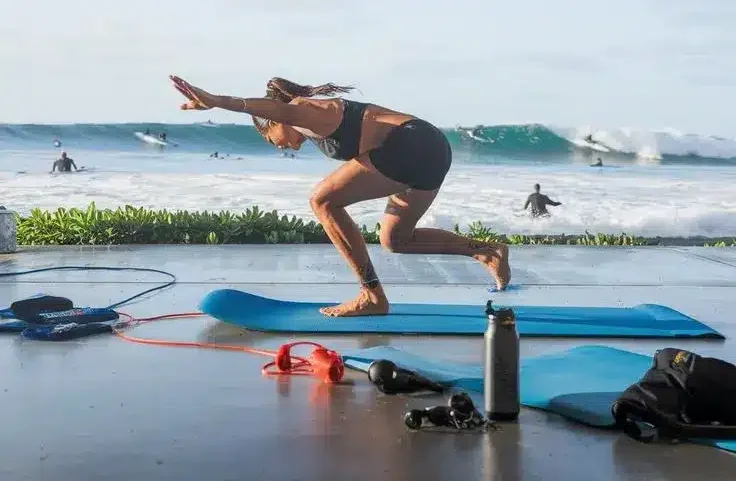
The routine is structured to mirror surfing’s actual physical demands: explosive movements (burpees, push-ups, mountain climbers) simulating the pop-up and quick reactions in the water; stability work (planks) for holding position on the board; unilateral leg work (lunges) for the asymmetric stance of surfing. Twenty minutes, nowhere to be, no kit — there’s no excuse for not training.
Balance and Coordination Training for Surfers
This is the pillar that translates most directly to what you feel in the water. A good balance training practice won’t necessarily make you stronger or fitter in measurable ways, but it will change how your body reacts on the wave — the small automatic adjustments that separate flowing surfing from tentative surfing. Ten minutes of daily balance work over eight weeks will make a noticeable difference in the water. This matters exponentially more on serious waves — the surfers tackling Nazaré or other powerful point breaks have balance work as a daily non-negotiable, not an afterthought.
Balance Board Drills
The most effective single piece of surf training equipment. A balance board (roller style, not the rocker style) places you on an unstable surface that demands constant micro-corrections — the exact skill surfing requires. Start with simple standing balance: feet in surf stance (front foot angled 45°, back foot perpendicular), hands relaxed, eyes forward. Hold for 2-minute rounds. Progress to squats on the board, then single-leg balance, then standing up from a seated position on the board. When all of those feel easy, add eyes-closed work.
Bosu Ball Work
Bosu balls (half-ball, flat side down for harder work) train a different kind of balance — multi-directional rather than single-axis. Squats on a bosu, single-leg balance on a bosu, planks with feet on a bosu — all progress your stability in directions a simple balance board doesn’t hit. Add these twice a week as a complement, not a replacement.
Single-Leg Drills (Anywhere)
No equipment needed. Brush your teeth standing on one leg. Put your socks on standing on one leg. These count. Formal drills: single-leg Romanian deadlift (reach toward the floor, hinge at the hip, keep your standing leg slightly bent), single-leg calf raises, and star balances (standing on one leg, reach the other leg out in eight compass directions). 2 minutes per leg daily will build ankle and hip stability faster than almost any gym exercise.
Surf Training Equipment Worth Buying
You don’t need a home gym. You need four specific pieces of equipment that, combined, cover 95% of what a surfer actually needs to train. Total investment: around $200–$300 depending on brand choices.
1. Balance Board
The non-negotiable purchase. Indo Board and Revbalance are the two dominant brands. Both use a flat board that sits on a cylindrical roller — when you stand on the board, it wants to roll, and you have to continuously correct. Budget around $120–$180 for a quality setup. Cheaper boards (under $60) exist but the rollers are often plastic and the boards flex unpredictably. This is a 5-year+ piece of equipment; don’t cheap out.
2. Surf Training Mat
Essential alongside a balance board — the mat protects the floor when you fall (and you will fall) and gives you a non-slip surface for push-ups, planks, and stretching. A thick yoga-style mat (5–6mm) works fine, but dedicated surf training mats are slightly longer (fitting a balance board plus room to practise pop-ups from prone). Budget around $40–$60.
3. Resistance Bands
The most versatile single piece of training equipment. A set of looped bands (light, medium, heavy) lets you do paddle simulations, pull-aparts for shoulder health, assisted pull-ups, and resistance-added squats. Budget around $30 for a quality set. Look for fabric-covered bands rather than pure latex — they last longer and don’t dig into skin.
4. Foam Roller
Recovery, not training. A standard-density foam roller for 5–10 minutes after sessions breaks up the tightness that accumulates in the lats, upper back, and hips from repetitive paddling. Budget $25–$40. A trigger-point massage ball does similar work for hard-to-reach spots like the shoulders and glutes — worth adding for $10.
Surf Training Equipment Summary
| Equipment | What It Trains | Budget | Priority |
|---|---|---|---|
| Balance board (Indo / Revbalance) | Proprioception, surf-specific balance | $120–$180 | Essential |
| Training mat (5–6mm) | Floor protection + non-slip surface | $40–$60 | Essential |
| Resistance band set | Paddle drills, shoulder health | $30 | Essential |
| Foam roller + massage ball | Recovery, mobility | $35–$50 | Highly recommended |
| TRX suspension trainer | Full-body bodyweight work | $100–$150 | Optional upgrade |
| Bosu ball | Multi-directional balance | $80–$120 | Optional upgrade |
The 4-Week Surf Fitness Programme
Structure beats intensity. The programme below ramps you from foundation to full routine over four weeks — long enough to build real capacity, short enough to feel committed-to rather than open-ended. Each week has 5 training days and 2 rest days. Ideally sync the rest days with your surf sessions so you’re fresh in the water.
Week 1: Foundation
The goal this week is building habit, not maximising output. Don’t try to hit personal bests. Move consistently, get the motor patterns right, and end each session feeling like you could have done more.
| Day | Session | Duration |
|---|---|---|
| Monday | Home bodyweight workout (2 rounds) | 20 min |
| Tuesday | Balance board (10 min) + mobility (10 min) | 20 min |
| Wednesday | Rest / surf | — |
| Thursday | Resistance band paddle drill + core | 25 min |
| Friday | Home bodyweight workout (2 rounds) | 20 min |
| Saturday | Balance board + single-leg drills | 15 min |
| Sunday | Rest / surf | — |
Week 2: Build
Add intensity. Bodyweight workouts go to 3 rounds. Paddling work adds the rowing interval session. Start pushing the balance board into single-leg territory.
| Day | Session | Duration |
|---|---|---|
| Monday | Home workout (3 rounds) + balance | 35 min |
| Tuesday | Gym Day 1 (pull + core) or rowing intervals | 45 min |
| Wednesday | Rest / surf | — |
| Thursday | Paddle band drills + shoulder mobility | 30 min |
| Friday | Gym Day 2 (legs + power) or home workout | 45 min |
| Saturday | Balance board (single-leg focus) | 20 min |
| Sunday | Rest / surf | — |
Week 3: Power
Peak intensity week. Four strength/cardio sessions, two balance sessions. This is where most people feel the biggest jump in-water — by the end of this week, you should notice visibly faster pop-ups and a full paddle-fitness session without being gassed.
| Day | Session | Duration |
|---|---|---|
| Monday | Gym Day 1 (pull + core) | 50 min |
| Tuesday | Paddle drills + balance board | 40 min |
| Wednesday | Gym Day 2 (legs + power) | 50 min |
| Thursday | Rest / surf | — |
| Friday | Gym Day 3 (push + full body) | 50 min |
| Saturday | Home workout + balance board | 35 min |
| Sunday | Rest / surf | — |
Week 4: Peak and Sport-Specific
Maintain the volume, add sport-specific drills. This week you start incorporating pop-up practice on the mat, simulated paddling under fatigue, and balance board work with eyes closed. By the end of the week you should be surfing noticeably better than when you started — not because you’ve surfed more, but because your body is now physically ready for what surfing actually demands. This is the fitness level that lets you genuinely enjoy a proper surf trip rather than surviving it — the point at which planning a week in one of the best surf destinations actually pays off.
After week 4: continue the programme indefinitely at the week 3 volume (which is sustainable long-term), or cycle back to a week 1 intensity for a recovery week before restarting.
Nutrition and Recovery for Surfers
Training hard without recovering properly is worse than not training at all. Three principles cover 90% of what matters: eat enough protein (1.6–2g per kg of bodyweight daily), hydrate consistently (salt water dehydrates you faster than you think), and sleep seven or more hours a night. Every other nutrition and recovery tactic — supplements, cold plunges, specific meal timing — is marginal gains compared to getting those three fundamentals right.
Pre-session: eat 60–90 minutes before surfing, moderate in carbs and protein, light on fat. Oats and banana, or toast and eggs, work well. Post-session: eat within 60 minutes — protein plus carbs is ideal. A decent meal rather than a shake is usually fine. Hydration is the single most overlooked factor: most surfers are mildly dehydrated most of the time, which directly limits paddling endurance and shortens session length. Carry water to the beach and drink before and after every surf.
Surf Fitness Checklist — Getting Started
- ☑ Start with the 20-minute home workout three times a week — build habit first
- ☑ Add 10 minutes of balance board work daily as soon as possible
- ☑ Do resistance band paddle drills once a week minimum
- ☑ Prioritise pulling movements over pushing — your shoulders will thank you
- ☑ 10 minutes daily shoulder mobility is non-negotiable for anyone surfing long-term
- ☑ Once fitness is there, use it: plan a real surf trip — Portugal, Morocco, Costa Rica, or France
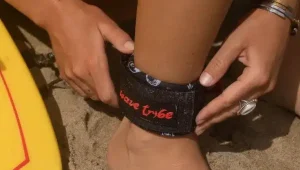
- ☑ Get the gear right: wetsuit, surf leash, proper fins
- ☑ Surf watch with tide tracker helps you plan sessions around the best conditions
- ☑ Surf hat for UV protection during long paddles in summer
Frequently Asked Questions
How often should I train for surfing?
Three to four structured training sessions a week is the sweet spot — enough stimulus to drive adaptation, enough rest to recover. Include balance board work daily (10 minutes is fine) as it’s low-impact and recovers quickly. Adjust down if you’re surfing 4+ times a week already; adjust up if you surf rarely and are training specifically to prepare for a trip. If you’re very new to surfing, training for fitness matters less than getting proper time on the right equipment — the right beginner surfboard will let you catch waves and build water confidence faster than any gym programme.
Can I train for surfing at home?
Yes — entirely. The 20-minute bodyweight routine in this article covers the major movement patterns, and adding a balance board plus a resistance band set gives you everything you need for complete surf-specific training. A gym helps for loaded strength work, but is genuinely optional. Many surfers train exclusively at home and progress well.
What’s the best exercise for paddling?
Resistance band paddle drills are the single most specific exercise — they mimic the exact movement pattern under resistance, building the right muscles in the right way. For general paddling fitness, the rowing machine is unmatched. For strength foundation, pull-ups and rows. The combination of those three covers every aspect of what paddling demands.
How long before I see results from surf fitness training?
Neural adaptations (feeling more coordinated, balance improving) happen in 1–2 weeks. Strength improvements become noticeable around 3–4 weeks. Cardiovascular/paddling fitness takes 4–6 weeks of consistent work. Visible body composition changes are secondary to actual performance changes — focus on what you can do in the water, not what you look like.
Should I do cardio or strength training for surfing?
Both. Surfing demands cardio (paddling endurance) and strength (pop-ups, turns) — training only one creates bottlenecks. The ideal split: 2–3 strength sessions a week, 1–2 cardio sessions (rowing or cycling intervals), plus daily balance work. The 4-week programme above structures this.
What are the best exercises for pop-ups?
Explosive push-ups, burpees, and box jumps cover the movement pattern best. Burpees are closest to the actual pop-up motion — the ground-to-standing transition is nearly identical. Do them properly: full push-up at the bottom, explosive jump up to vertical at the top. Three sets of 10 twice a week will directly improve your pop-up speed in the water.
Does a balance board actually help with surfing?
Yes, more than almost any other training tool. Balance board work trains the specific proprioceptive adjustments surfing demands, in a way that translates remarkably well to the water. Ten minutes a day, five days a week, for eight weeks produces noticeable improvements in how you feel on the wave — specifically in how early your body reacts to the surface moving under you.