
I’ve snapped three leashes in my surfing life. The first was a cheap, over-aged urethane cord that gave up in waist-high shore break — annoying but harmless. The second was a thin comp leash I’d stubbornly kept using in overhead surf because it felt “better” on small days — that one cost me a long swim and a trashed fin. The third taught me the lesson properly: a leash is the cheapest piece of safety equipment you’ll own, and using the wrong one is a false economy. This guide walks through everything I wish I’d known before buying my first serious leash — how to pick the right size, the right thickness, and the brands that genuinely last.
Worth Knowing Before You Buy
- ✓ Leash length should roughly match your board length — a 6’0″ shortboard wants a 6′ leash, a 9’0″ longboard wants a 9′ leash
- ✓ Thickness (cord diameter) matters more than most surfers think — 6mm for small-to-medium waves, 7mm for solid surf, 8mm+ for overhead and heavy conditions
- ✓ Quality swivels prevent tangles and cord twist — cheap leashes fail at the swivel first
- ✓ Replace your leash every 12–18 months of regular use, or immediately if you see stretching, kinks, or cord damage
- ✓ Budget $30–$50 for a quality all-round leash that will last a full season of regular surfing
Quick Guide — Best Surf Leashes
- Best overall: Dakine Kainui Team — The benchmark all-purpose leash ($45 / €42)
- Best for performance shortboarding: FCS All Round Essential — Balanced stretch and recoil, clean design ($40 / €38)
- Best big wave leash: Creatures of Leisure Pro 8ft — Built for powerful surf ($60 / €57)
- Best longboard leash: Dakine Longboard 9ft Ankle — Calf cuff option, purpose-built ($50 / €47)
- Best budget: Ocean & Earth One-XT — Genuine quality at entry price ($28 / €26)
- Best SUP/paddle leash: Dakine SUP Coiled Leash — Essential for flatwater and downwind ($55 / €52)
- Best comp leash: FCS Competition 6ft — Thin, light, high-performance ($42 / €40)
Why Your Surf Leash Matters More Than You Think
A surf leash is the cord connecting your ankle (or calf) to your surfboard — simple in concept, critical in function. It does two things: it stops your board from drifting to the beach after a wipeout, and it stops your board from becoming a loose projectile in a crowded lineup. Both matter. The first affects your session — every minute spent swimming after your board is a minute not surfing. The second affects everyone else in the water — an unleashed board in a crowd is genuinely dangerous.
Beyond function, there’s reliability. A leash that snaps in shore break is an inconvenience. A leash that snaps in overhead surf at a reef break, or half a mile out on a point, is a serious situation — think the kind of waves that roll through Hossegor or Ericeira on a solid swell. The difference between a $15 supermarket leash and a $45 proper brand leash isn’t marketing — it’s the urethane compound, the swivel construction, the stitching quality at the rail saver, and the manufacturing tolerances that determine whether it holds up when you need it most.
Surf Leash Anatomy: Understanding the Parts
Cord Material and Construction
Surf leash cords are made from urethane — a stretchy, durable synthetic that returns to its original length after being pulled taut. Quality varies significantly between brands. Cheap urethane develops kinks, loses elasticity, and becomes brittle over a season or two of UV exposure. Quality urethane (Dakine, FCS, Creatures, Ocean & Earth at their proper price points) resists degradation and maintains its recoil properties for years. The difference is invisible in the shop — you only notice it when a cheap leash snaps or when your 5-year-old Dakine still holds up fine.
Cord Thickness
This is the specification most surfers ignore and shouldn’t. Cord diameter directly determines breaking strength. Standard thicknesses and their use cases:
| Thickness | Wave Size | Use Case |
|---|---|---|
| 5mm | Knee–waist high | Competition leashes, small-wave only |
| 6mm | Waist–head high | Standard all-purpose shortboard |
| 7mm | Head high–overhead | Solid surf, longboards, heavier surfers |
| 8mm+ | Double-overhead+ | Big wave leashes, reef breaks, tow-in |
Thinner leashes have less drag through the water, which is why competitors use 5mm comp leashes in small waves. But in overhead surf, a thin leash is more likely to snap under the load of a proper wipeout. If you’re buying a single all-purpose leash, 6mm is the right answer. If you’re building a small quiver, add a 7mm for bigger days.
Swivel Systems
Swivels are the metal joints at each end of the cord that allow it to rotate independently from the cuff and the rail saver. Without swivels, the cord would twist around itself every time you turn — within minutes the leash would be knotted into uselessness. Quality leashes have double swivels (one at the cuff, one at the rail saver) or triple swivels (plus one in the middle of the cord) on longer longboard leashes. Swivel quality is the single biggest predictor of leash longevity — cheap leashes fail at the swivel first, either seizing up from corrosion or coming apart mechanically.
Cuff Design
The cuff is the padded band that wraps around your ankle or calf. Standard shortboard cuffs are ankle-mounted with neoprene padding and a velcro closure. Longboard cuffs are often larger and sometimes calf-mounted — calf attachment keeps the leash out of the way when cross-stepping and nose-riding. Quality cuffs have a hidden key pocket (useful for car keys), reinforced stitching at load points, and neoprene that doesn’t chafe after a few hours in the water. Cheap cuffs abrade your skin, lose padding, and come loose when you need them most.
Rail Saver and Leash String
The rail saver is the flat velcro-closed strap at the board end of the leash. It wraps around the tail of the board and prevents the leash cord from cutting into your rail when it pulls taut. The leash string is the thin cord that loops through your board’s leash plug and connects to the rail saver. Always use a proper leash string — the thin braided cord sold with new leashes — rather than trying to tie the rail saver directly into the plug. A dedicated leash string is designed to fail before your rail saver tears, protecting the more expensive components.
Surf Leash Length Guide: Matching Your Board
The rule is simple: leash length should equal or slightly exceed your board’s length. Too short and your board snaps back at you in wipeouts; too long and the excess drags, tangles, and adds unnecessary resistance. If you’re not sure about your board’s size to begin with, my surfboard size chart covers the full logic. Here’s the full leash breakdown by board type:
Leash Length by Board Type
| Board Type | Board Length | Leash Length | Thickness |
|---|---|---|---|
| Performance shortboard | 5’6″–6’4″ | 6 ft | 6mm |
| Fish / groveler | 5’4″–6’0″ | 5.5–6 ft | 6mm |
| Mid-length | 6’6″–7’6″ | 7 ft | 6–7mm |
| Short longboard | 8’0″–8’6″ | 8 ft | 7mm |
| Classic longboard | 9’0″–9’6″ | 9 ft | 7mm |
| Big board / log | 10’0″+ | 10 ft | 7–8mm |
| Step-up / big wave | 6’4″–7’6″ | 7–8 ft | 8mm+ |
| SUP | Varies | Coiled, 8–10 ft | Coiled specific |
Why Bigger Surfers Sometimes Need Longer Leashes
The board-length rule assumes average build. If you’re taller or heavier, you generate more force in a wipeout and need more stretch room before the cord fully loads. A 6’4″ surfer on a 6’2″ board may want a 7′ leash rather than a 6′ for this reason. Similarly, surfers with longer legs may find that a leash matching board length leaves them with the board snapping back close after wipeouts — going up one size creates a safer buffer. (If you’re still choosing a board, the surfboard volume calculator helps get the sizing right before you worry about leash length.)
SUP and Paddle Surf Leashes
Stand-up paddle boarding uses a different leash type — a coiled leash that sits in a spring-like coil on top of the board rather than trailing in the water. The reason is simple: on flatwater and downwind SUP, a straight leash would catch in the fin, wrap around the paddle, and create constant drag. Coiled leashes eliminate all of that. For SUP surfing in the ocean, opinions vary — some surfers use straight leashes (better in waves), others stick with coiled (no drag when cruising). Whatever you pick, SUP leashes should attach to the calf rather than the ankle — a falling SUP is much heavier than a surfboard and an ankle attachment creates strain under load.
Types of Surf Leashes
All-Purpose Leashes
The standard daily-driver leash. 6mm or 7mm cord, standard length matched to board, double swivels, comfortable cuff, durable construction. If you’re buying one leash to cover most of your surfing, this is the category. Dakine Kainui, FCS All Round Essential, Ocean & Earth One-XT — all are excellent all-purpose leashes. Expect to spend $30–$50 and get 12–18 months of hard use out of a quality model.
Competition Leashes
Thin, lightweight, and designed for small to medium surf. Typically 5mm cord, minimal cuff padding, streamlined everything. The appeal is reduced drag — the difference is subtle but real, and in competition contexts it matters. The trade-off is reduced durability and lower breaking strength, so comp leashes are not the right choice when waves get solid. Don’t make the mistake of using a comp leash as your all-purpose leash just because it “feels better” — it will fail you in bigger conditions.
Big Wave Leashes
8mm+ cord, reinforced everything, often with a quick-release mechanism at the cuff. Designed for double-overhead+ surf where the force of a wipeout can snap standard leashes — we’re talking the kind of conditions that pile up at Nazaré or, on a smaller but still serious scale, the cold-water giants at Bundoran. The quick-release matters — in genuine big wave situations, being attached to a board that’s being dragged by a heavy wave is more dangerous than being separated from it. Creatures of Leisure, FCS Tour, and Dakine all make proper big wave leashes. If you’re surfing genuine big waves, don’t use a standard leash — the risk isn’t worth the saving.
Coiled Leashes
Primarily for SUP and occasionally for tow-in and wave pool contexts. The coiled design keeps the cord out of the water — useful in pool contexts where a trailing cord can catch on other surfers, and on SUP where drag matters. Not generally recommended for standard ocean surfing: coiled leashes transmit board movement back to your ankle in ways that straight leashes don’t, and the coil can snag on things.
Tow-In Leashes
Specialist gear for tow-in surfing — much shorter (3–4 ft) and typically attached to a waist belt rather than an ankle. Not relevant for most surfers, but worth knowing the category exists. If you’re tow-in surfing, you’re past the point where this guide is useful anyway.
My Top 7 Surf Leash Picks
Dakine Kainui Team — Best Overall
What I Like:
- Reference-standard all-purpose leash: The Kainui Team is the leash most surf shops will hand you when you ask for “a good leash” — it’s the benchmark that every other all-purpose leash gets compared to
- Quality urethane that lasts: Dakine’s urethane compound holds its recoil for years without the kinking or brittleness that plagues cheaper leashes
- Double stainless-steel swivels: The swivels are the part that usually fails first; Dakine’s hold up consistently
- Padded cuff with hidden key pocket: Neoprene padding is thick enough to prevent chafing on long sessions, and the hidden key pocket is genuinely useful
- Multiple sizes available: 6, 7, 8, 9, and 10 ft options with 6mm, 7mm, and triple-swivel variants — one range covers every board type
What Could Be Better:
- Not the cheapest option — but it will outlast two or three budget leashes, so the maths works out
- The colour options are limited — functional aesthetic, not fashion-forward
- The cuff runs slightly large — smaller surfers may find it bulkier than necessary
Best for: Almost every surfer; especially those buying their first quality leash or replacing a worn-out one; daily-driver setup for shortboarders and mid-lengths
| Length | Thickness | Swivels | Price |
|---|---|---|---|
| 6, 7, 8, 9, 10 ft | 6mm or 7mm | Double (triple on 9’+) | $45 / €42 |
FCS All Round Essential — Best for Performance Shortboarding
What I Like:
- Cleaner design than the Dakine Kainui: The FCS All Round has slimmer profiles on the cuff and rail saver — more streamlined for performance surfing
- Excellent stretch-to-recoil ratio: The urethane stretches predictably under load and returns to length without kinks or memory
- Low-profile cuff: Thinner neoprene padding than the Dakine — less bulky but equally comfortable for most surfers
- FCS’s manufacturing is rock-solid: Same brand behind FCS II fin system — they know their way around surf hardware
What Could Be Better:
- Thinner cuff padding is comfortable for short sessions but can chafe on all-day surfs
- Slightly less durable than Dakine over long periods of hard use — 12 months rather than 18+
- Lower weight rating than big-wave specific leashes — not the right choice for genuine overhead surf
Best for: Performance shortboarders, surfers who prioritise a low-profile feel, those already in the FCS ecosystem (fins, traction pads, leash = matched setup)
| Length | Thickness | Swivels | Price |
|---|---|---|---|
| 6, 7, 8 ft | 6mm or 7mm | Double | $40 / €38 |
Creatures of Leisure Pro 8ft — Best for Big Waves
When waves get solid — overhead to double-overhead — standard leashes become a liability. The Creatures Pro 8ft is built for exactly that scenario: thicker cord (7–8mm), reinforced rail saver, premium double swivels, and cuff construction that handles the shock load of a serious wipeout. I use a Creatures Pro on my step-up board specifically for bigger days, and the confidence factor is real. When you know your leash won’t fail, you surf differently in heavy conditions.
What I Like:
- Purpose-built for solid surf: Every component is upgraded from standard — thicker cord, stronger swivels, more robust rail saver
- Creatures reputation in heavy-water construction: The brand is trusted by surfers at reef breaks and point surf; when your equipment matters, Creatures delivers
- Excellent cuff stability: Wide padded cuff with secure velcro that doesn’t slip under heavy load
- Available with quick-release: Specific versions include a quick-release tab at the cuff for genuine big wave scenarios
Best for: Surfers in reef breaks, point surf, or anywhere waves regularly hit overhead; step-up boards; those who want one reliable leash for bigger conditions. If your regular quiver includes a step-up for big-wave travel destinations, this is the leash that goes in the board bag.
| Length | Thickness | Swivels | Price |
|---|---|---|---|
| 7, 8, 9 ft | 7–8mm | Double (heavy-duty) | $60 / €57 |
Dakine Longboard 9ft Ankle — Best Longboard Leash
Longboards need their own category. Longer boards generate more force in wipeouts (simple physics — more mass, more momentum), and the geometry of a long leash means swivels matter even more. The Dakine Longboard 9ft is built around triple swivels to prevent the cord twist that plagues cheap longboard leashes, with a 7mm cord that handles the load. Available in ankle or calf cuff — for classic longboarding with cross-stepping and nose-riding, the calf cuff is genuinely worth having.
Best for: All longboard surfers; nose-riders and classic longboarders specifically benefit from the calf cuff version
| Length | Thickness | Swivels | Price |
|---|---|---|---|
| 9, 10 ft | 7mm | Triple | $50 / €47 |
Ocean & Earth One-XT — Best Budget
Ocean & Earth make genuinely good surf hardware at prices below the big premium brands. The One-XT is their standard all-round leash — 6mm or 7mm cord, double swivels, reasonable cuff padding, and construction that holds up for a full season of regular surfing. Is it as refined as a Dakine Kainui? No. Does it cost $17 less and work well? Yes. Perfect as a first proper leash for someone upgrading from a cheap supermarket leash, or as a spare that lives in your travel bag for Portugal surf camps, Morocco trips, or summer sessions in France.
| Length | Thickness | Swivels | Price |
|---|---|---|---|
| 6, 7, 8, 9 ft | 6mm or 7mm | Double | $28 / €26 |
Dakine SUP Coiled Leash — Best for Paddle Surfing
SUP-specific, calf-mounted, coiled construction. The coil keeps the cord off the deck and out of the fin, eliminating drag on flatwater and downwind SUP. Dakine’s version is the standard most SUP shops stock because it genuinely works — quality swivels, solid cuff, and the coil holds its spring for years rather than stretching out into a permanent mess like cheap coiled leashes. Essential gear for SUP; don’t compromise here.
| Length | Type | Cuff | Price |
|---|---|---|---|
| 8–10 ft coiled | Coiled urethane | Calf-mounted | $55 / €52 |
FCS Competition 6ft — Best Comp Leash
For small-wave, performance-focused sessions only. 5mm cord, minimal cuff, streamlined rail saver — the whole design is about reducing drag and weight. On a knee-high day on a proper shortboard, the difference is noticeable: your board feels lighter, turns faster, and the leash genuinely disappears from your awareness. Not appropriate for anything above chest-high surf or for heavier surfers even in small waves. Buy this as a specialist addition, not as your primary leash.
| Length | Thickness | Wave range | Price |
|---|---|---|---|
| 6 ft | 5mm | Knee–chest high only | $42 / €40 |
How to Attach Your Surf Leash: Step-by-Step
Attaching a leash correctly matters — a poorly attached leash can saw through your rail, tear out a leash plug, or release at the worst possible moment. The correct method takes thirty seconds and protects $800 of board.
Step 1: Prepare Your Leash String
Every new leash comes with a leash string — a thin braided cord about 12–15cm long. If your leash didn’t come with one, buy a replacement ($2–3 at any surf shop). Don’t skip this step and don’t substitute rope, bootlaces, or anything else. The leash string is engineered to fail before your rail saver under catastrophic load — this protects the more expensive components.
Step 2: Thread Through the Leash Plug
Your board has a small plug near the tail (usually on the deck, close to the stringer). Push the loop of the leash string through this plug from underneath. Thread the two loose ends of the string up through the loop you’ve created — this forms a cow hitch (also called a lark’s head knot). Pull the ends tight. The string should now be firmly anchored in the plug with both ends protruding from the top of the board.
Step 3: Attach the Rail Saver
Open the velcro on the rail saver. Thread the leash string through the fabric loop at the end of the rail saver. Wrap the rail saver around the tail of the board so that when the leash pulls taut, the flat padded section of the rail saver is sitting against the rail of the board (not the narrow cord). Close the velcro firmly. Check that no leash string is sticking out awkwardly — tuck any loose ends.
Step 4: Check the Length of the String
The leash string should be short — when the rail saver is closed around the tail, the string should be almost invisible. If the string is too long, the rail saver won’t sit properly against the rail and the cord can cut into your board during wipeouts. If your string came too long, re-knot it shorter or replace it with a properly-sized one.
Step 5: Fit the Cuff
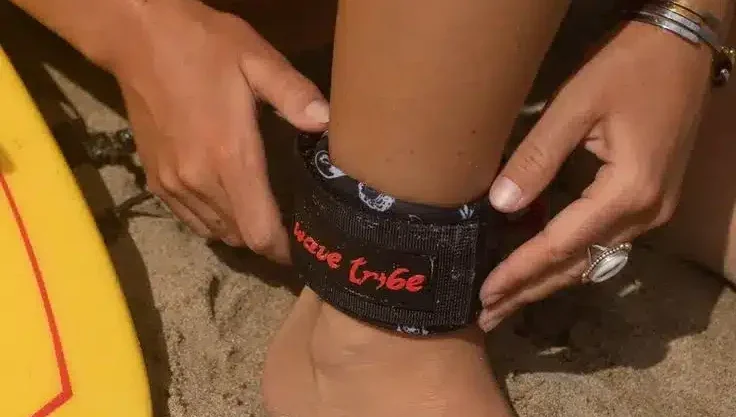
The cuff wraps around your back leg’s ankle (or calf, depending on the leash type). Orient it so the swivel and cord exit the cuff at the back of your leg — this keeps the cord away from your feet and reduces the chance of tangling during pop-ups. Snug but not tight: you should be able to slip two fingers under the cuff without struggle. Too tight restricts circulation on long sessions; too loose lets the cuff rotate during surfing.
Surf Leash Care and Maintenance
Rinse After Every Session
Salt corrodes swivels and degrades urethane over time. A quick fresh-water rinse after each surf removes the majority of the damage before it happens. Rinse the whole leash — cord, cuff, rail saver, swivels — and let it air dry out of direct sunlight. This single habit adds months to a leash’s life.
Storage
Coil your leash loosely when storing — tight coiling creates memory in the cord, leading to permanent kinks. Hang it on a hook or coil it in a board bag rather than leaving it tangled in a wet pile. UV is the hidden enemy of leash cords; storing leashes out of direct sunlight (board bag, garage, indoor rack) dramatically extends their usable life.
Signs to Replace Your Leash
Replace the leash immediately if you see any of the following: visible kinks or permanent bends in the cord, a brittle or chalky feeling on the urethane surface, swivels that seize or don’t rotate freely, cuts or abrasions deeper than 1mm into the cord, torn or abraded stitching at the rail saver, or any stretching where the cord has permanently lengthened beyond original spec. A quality leash rarely fails visually without warning — if you spot any of these signs, the next wipeout might be the one where it lets go.
Even without visible damage, replace your leash every 12–18 months of regular use (2+ sessions a week). Urethane degrades invisibly with UV exposure, and a leash that looks fine can still be at 60% of its original breaking strength.
Surf Leash Checklist — Before You Buy
- ☑ Match leash length to your board length (or slightly longer for heavier surfers)
- ☑ Choose cord thickness based on typical wave size (6mm all-round, 7mm+ for bigger surf)
- ☑ Confirm your board has a functional leash plug — replace it if worn
- ☑ Pick a cuff type: ankle for most, calf for longboard classic-style
- ☑ Double swivels minimum; triple for leashes 9ft+
- ☑ Budget $30–$50 for quality; avoid leashes under $20 unless it’s a short-term backup
- ☑ Don’t forget a leash string — keep a spare in your board bag
- ☑ Pair with the right wetsuit for your water temperature
- ☑ Surf hat for UV protection on long sessions
- ☑ Surf watch with tide tracker to plan sessions around optimal conditions
- ☑ An outfit from your favourite surf clothing brand for post-session
Frequently Asked Questions
What size surf leash do I need?
Match leash length to your board length, rounded up to the nearest foot. A 5’10” shortboard uses a 6ft leash; a 7’0″ mid-length uses a 7ft leash; a 9’2″ longboard uses a 9ft leash. Taller or heavier surfers (over 90kg) can consider going up one size for added safety margin in wipeouts.
Can I use any leash on any board?
Mechanically yes — standard leash plugs accept standard leash strings regardless of brand. But you shouldn’t use the wrong leash for your board. A comp leash on a longboard will snap under load; a big-wave leash on a shortboard will feel like dragging a rope through the water. Match the leash to the board type.
How tight should the cuff be?
Snug but not restrictive. You should be able to slide two fingers under the cuff without struggle. Too tight restricts blood flow on long sessions; too loose allows the cuff to rotate around your ankle during surfing, which can twist the cord and put strain on the swivel.
Why did my surf leash snap?
Most leash failures fall into four categories: age/UV degradation (leash was old and the urethane had hardened), wrong thickness for conditions (5mm comp leash in overhead surf), damaged cord that wasn’t replaced (existing kink or cut that propagated), or catastrophic wipeout that exceeded the leash’s rated load. If your leash snapped without obvious damage, it was probably at end-of-life — replace rather than continuing to use.
Ankle vs. calf leash — which is better?
Ankle is standard for shortboarding and most general surfing — the cuff stays out of the way and works reliably. Calf attachment is specifically useful for classic longboarding where nose-riding and cross-stepping mean you’ll step on an ankle leash repeatedly. For SUP, calf is strongly recommended because the weight of a falling SUP on an ankle leash creates strain. Outside those two cases, ankle is the right default.
What’s a leash string and do I need a new one?
The leash string is the short thin cord that connects your rail saver to the leash plug on your board. Every new leash comes with one; if yours is missing or worn, any surf shop sells replacements for a few dollars. Always use a proper leash string rather than substituting rope — the string is designed to fail before your rail saver and board under extreme load, protecting the more expensive components.
How often should I replace my surf leash?
Every 12–18 months for regular surfers (2+ sessions per week), or immediately if you notice visible damage, kinks, or degraded urethane. Even leashes that look fine lose strength from UV exposure, and a cheap leash that’s been in the sun for a summer can be at half its original breaking strength invisibly.