
Three words. No explanation needed — at least not in Hawaii. “Eddie Would Go” is one of the most loaded phrases in all of surf culture, a sentence that carries an entire philosophy of courage, humility, and aloha inside it. I first heard it on a worn bumper sticker in a car park at Sunset Beach and had no idea what it meant. Once you understand who Eddie was and what he did, those three words hit differently. Here’s the full story.
Quick Guide — Eddie Would Go
🌊 What it means: A phrase symbolising courage — going when no one else would, doing the right thing regardless of the danger
🏄 Who Eddie was: Eddie Aikau — Native Hawaiian surfer and Waimea Bay’s first lifeguard, who saved over 500 lives
💬 Where it came from: Mark Foo, 1985 — said at the first Eddie contest as organisers debated the enormous waves
⚓ How Eddie died: 1978, paddling toward Lānaʻi on his surfboard after the Hōkūleʻa voyaging canoe capsized — he was never found
🏆 The contest: The Eddie Aikau Big Wave Invitational at Waimea Bay — only held when waves reach 20 feet or more
📖 Beyond surfing: A life philosophy — bumper stickers, tattoos, a Google Doodle, and an Emmy-winning documentary
Who Was Eddie Aikau?
Edward Ryan Makua Hanai Aikau was born on May 4, 1946, in Kahului, Maui. He was the second child of Solomon and Henrietta Aikau, and his full name carries deep meaning — Makua Hanai translates to “feeding parent” or “nurturing, fostering parent” in Hawaiian. The family moved to Oʻahu in 1959, and at 16, Eddie left school and started working at the Dole pineapple cannery, saving up enough to buy his first surfboard.
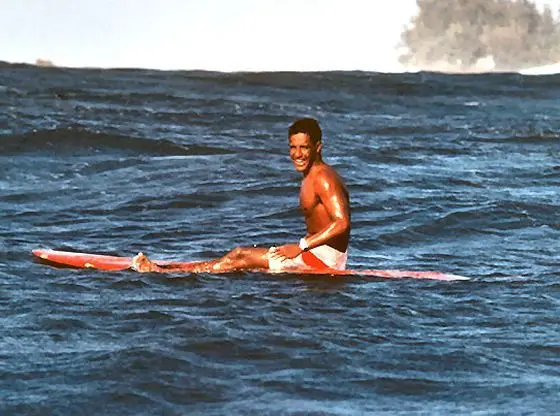
By the mid-1960s, Eddie had discovered Waimea Bay — the deep-water break on the North Shore of Oahu that, when the winter swells arrive, produces some of the largest and most dangerous rideable waves on earth. In 1966, he surfed Waimea for the first time in a session that lasted six straight hours, catching over a dozen waves at 20 feet. He was not yet known. He was just a young Native Hawaiian in love with the most terrifying wave on his island.
In 1968, Eddie became the first lifeguard hired by the City and County of Honolulu to work the North Shore — tasked with covering the beaches between Sunset and Haleiwā. It was one of the most demanding lifeguard postings in the world. Eddie didn’t just manage the risk; he threw himself into it. He braved waves that regularly reached 30 feet or more, and over his career he saved the lives of more than 500 swimmers and surfers. Not one person was lost while he served at Waimea Bay. In 1971, he was named Lifeguard of the Year.
As a competitive surfer, Eddie won the Duke Kahanamoku Invitational Surfing Championship in 1977 — one of the most prestigious events in Hawaiian surfing, named after the man who brought surfing to the world. Duke Kahanamoku was Eddie’s predecessor as the defining Hawaiian waterman of his era, and winning his invitational carried enormous symbolic weight. Yet despite his talent and his record, Eddie was never truly part of the mainstream surf industry. He was low-profile, private, and deeply rooted in Hawaiian culture rather than the commercial surf scene building up around him.
The Hōkūleʻa and Eddie’s Disappearance
In 1978, the Polynesian Voyaging Society was planning a landmark voyage: a 2,500-mile journey from Hawaii to Tahiti aboard the Hōkūleʻa, a double-hulled voyaging canoe built to replicate the ancient craft used by Polynesian navigators. The voyage was a profound act of cultural reclamation — navigating without modern instruments, using only the stars, swells, and wind as the original Polynesian settlers had done centuries before. Eddie Aikau joined the crew.
The Hōkūleʻa left the Hawaiian islands on March 16, 1978. Twelve miles south of the island of Molokaʻi, one of the canoe’s hulls developed a leak and the vessel capsized in rough seas. The crew clung to the overturned hull, firing flares into the night. No rescue came.
In an attempt to get help for his crewmates, Eddie Aikau grabbed his surfboard and paddled alone toward Lānaʻi, the nearest land. The rest of the crew were eventually rescued by the U.S. Coast Guard Cutter Cape Corwin. Eddie was never seen again. He was 31 years old. The resulting search became the largest air-sea rescue operation in Hawaiian history. His body was never found.
What Eddie did that day — paddling alone into open ocean to save his crewmates — was entirely consistent with everything he had done on the beach at Waimea Bay for a decade. He went when others couldn’t. It cost him his life.
Where Did “Eddie Would Go” Come From?
The phrase was born in 1985, at the first major running of the Eddie Aikau Big Wave Invitational at Waimea Bay. The waves that day were enormous — 20 to 25 feet, windblown and dangerous. Contest organisers were debating whether conditions were safe enough to hold the event. As the discussion went on, big wave surfer Mark Foo looked out at the walls of water rolling through the bay and said simply: “Eddie would go.”
The contest went ahead. The phrase stuck. Within months it was on bumper stickers and T-shirts across the Hawaiian islands. Within years it had spread across the surf world and far beyond. Maritime historian Mac Simpson later articulated its deeper root: “Aikau was a legend on the North Shore, pulling people out of waves that no one else would dare to. That’s where the saying came from — Eddie would go, when no one else would or could. Only Eddie dared.”
The phrase was also, in a sense, older than the contest. According to Simpson, “the phrase ‘Eddie Would Go’ predates Hōkūleʻa” — Eddie’s reputation for doing what others wouldn’t was established long before his death. The contest and Mark Foo’s declaration just crystallised it into three words.
What Does “Eddie Would Go” Actually Mean?
“Eddie Would Go” means more than surfing big waves. The phrase has become a compact philosophy of courage, selflessness, and doing what needs to be done even when — especially when — it’s terrifying. In Hawaiian surf culture it is a measure of character: would you go when conditions are extreme and everyone else is hesitating? Would you paddle out when the waves are closed-out and dangerous? Would you do the right thing even if it puts you at risk?
For Eddie, “going” was never about ego or performance. His brother Clyde once said: “No one surfed like Eddie. He would take off on a huge scary wave, and he’d be sliding down it with the biggest smile you ever saw. The rest of us were nervous. Eddie belonged there; it was his home.” Eddie wasn’t fearless — he surfed with joy, not bravado. The going was simply what he did, because the wave was there and someone might need saving.
Stuart Holmes Coleman, who wrote the definitive biography of Eddie’s life, described it precisely: it’s “about more than just paddling into waves so big most people wouldn’t. It’s a phrase that permeates life in those moments when you’re called to take a risk to do what you feel in your soul is right.” “Eddie Would Go” became, as maritime historian Mac Simpson put it, “a semantic symbol of courage, commitment, perseverance, and aloha.”
The Eddie Aikau Big Wave Invitational
The Quiksilver in Memory of Eddie Aikau contest — universally called “The Eddie” — is one of the most unique sporting events in the world. It runs at Waimea Bay on the North Shore of Oahu, and the defining rule is that it only runs when waves are at least 20 feet on the face. This is not a formality. The contest has a waiting period from November to February each year and is only held when nature provides the right conditions. Some years it doesn’t run at all, and the waiting itself becomes part of the ritual.
Since 1985 The Eddie has been held only a handful of times — which is part of what gives it such weight. Being invited to compete is already an honour; actually surfing it is something else entirely. The invite list reads like a hall of fame of big wave surfing across the decades, from Andy Irons to John John Florence, who won the event in 2016 during one of the most memorable runnings in its history. Each contest opens with a ceremony at the beach where the Aikau family blesses the surfers and the kahu speaks of Eddie’s spirit watching over those who ride Waimea’s water.
The contest has always been about more than competition. It is a ceremony of remembrance as much as a surfing event — a way of keeping Eddie present in the water he loved. The surfers who compete know this. The crowds who line the cliffs and the beach know this. It is one of the few events in professional surfing where the result feels almost secondary to the act of showing up.
Eddie Would Go: Beyond Surfing
The phrase has moved far beyond the surf world. On May 4, 2019 — what would have been Eddie’s 73rd birthday — Google honoured him with a Doodle across multiple countries. The documentary Hawaiian: The Legend of Eddie Aikau, directed by Sam George, won an Emmy for Best Sports Documentary Series — one of the very few surf films ever to receive that recognition.
The phrase has generated its own variations within Hawaiian culture: “Eddie Wouldn’t Crow” (against boastful, egotistical surfers), “Eddie Would Hoe” (supporting Native Hawaiian agricultural outreach), and “Eddie Would Ride” (used in a 2008 Honolulu transit election campaign). Each riffs on the same structure — three words, past tense, Eddie as the standard.
For the famous surfers who came after Eddie, his legacy shapes how big wave surfing is understood culturally. The willingness to paddle out at Nazaré, at Jaws, at Shipsterns Bluff is always measured — consciously or not — against what Eddie did at Waimea and in open ocean on the Kaiwi Channel. He wasn’t trying to be remembered. He was just going.
Watch: Hawaiian — The Legend of Eddie Aikau (ESPN 30 for 30)
Eddie Aikau — Key Facts
- ☐ Born: May 4, 1946, Kahului, Maui, Hawaii
- ☐ Died: March 17, 1978 (aged 31) — lost at sea after the Hōkūleʻa capsized
- ☐ Lifeguard record: Over 500 rescues at Waimea Bay — not one life lost on his watch
- ☐ Surf achievement: Won the 1977 Duke Kahanamoku Invitational
- ☐ The phrase: Coined by Mark Foo at the first Eddie contest, 1985
- ☐ The contest: Held at Waimea Bay — only runs when waves reach 20+ feet
- ☐ What it means: Courage, selflessness, and doing what’s right when others hesitate
Frequently Asked Questions
Who coined the phrase “Eddie Would Go”?
Big wave surfer Mark Foo said it at the first major running of the Eddie Aikau Invitational at Waimea Bay in 1985. Contest organisers were debating whether to hold the event given the enormous, dangerous conditions. Foo looked at the waves and said “Eddie would go.” The contest went ahead, and the phrase entered surf culture permanently. Maritime historian Mac Simpson noted that the sentiment itself predated the contest — Eddie’s reputation for going where others wouldn’t was already legendary on the North Shore before his death in 1978.
How did Eddie Aikau die?
Eddie died on March 17, 1978, at the age of 31. He was a crew member aboard the Hōkūleʻa, a traditional Hawaiian voyaging canoe attempting a 2,500-mile journey from Hawaii to Tahiti. The canoe capsized in rough seas about 12 miles south of Molokaʻi. To get help for the crew, Eddie grabbed his surfboard and paddled alone toward the island of Lānaʻi. The crew were rescued by the U.S. Coast Guard; Eddie was never seen again. His disappearance triggered the largest air-sea search in Hawaiian history.
How often is the Eddie Aikau contest held?
The Eddie only runs when waves at Waimea Bay reach at least 20 feet on the face — roughly 40 feet in the Hawaiian measurement used for big wave surfing. The contest has a waiting period from November to February each year but is not guaranteed to run. Since it began in 1985, it has been held only a handful of times. Years can go by without the right conditions, which is part of what makes each running so significant.
Is “Eddie Would Go” only about surfing?
No. While the phrase emerged from big wave surfing culture, it has long since become a broader philosophy of courage and selflessness — doing what is right or necessary even when conditions are extreme and others are hesitating. It’s found on bumper stickers, tattoos, political slogans, and sporting campaigns far outside surfing. The phrase resonates because Eddie’s story isn’t really about surfing ability — it’s about character. He paddled into open ocean to save people, not to ride a wave. That’s the part that travels.
Who was Eddie Aikau’s brother Clyde?
Clyde Aikau is Eddie’s younger brother and a legendary Hawaiian surfer in his own right. He competed in the very first Eddie contest in 1985 — the one where Mark Foo coined the phrase — and eventually won that event after a tiebreaker with Mark Foo. Clyde has remained a guardian of Eddie’s memory and the Aikau family’s role in Hawaiian surf culture throughout his life. He appears at every Eddie contest opening ceremony and is one of the most important figures in keeping the story of Eddie’s life alive for new generations of surfers.