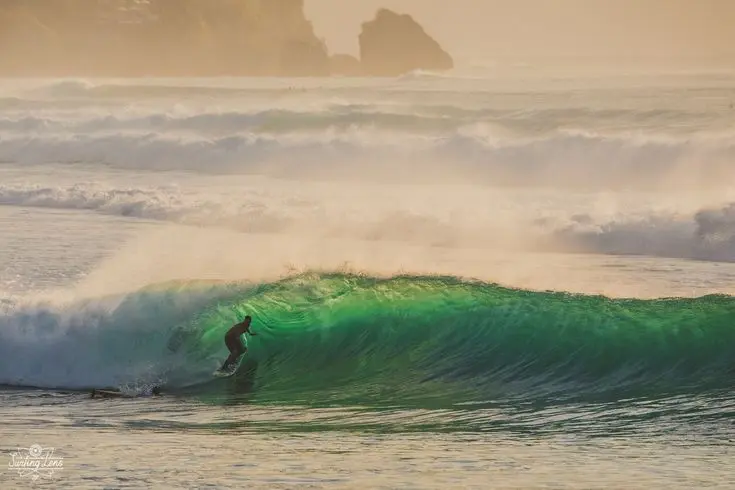

Every surfer has checked the tide before a session — high tide, low tide, incoming, outgoing. But slack tide is the one that often gets overlooked, even though understanding it can make a real difference to your session quality, your safety in the water, and your ability to read a break. Here’s what it is, why it matters, and how to use it.
Quick Guide — Slack Tide
⏸️ What it is: The brief pause in tidal movement when the water transitions between incoming and outgoing — neither flowing in nor out
⏱️ How long it lasts: Roughly 20–30 minutes, though this varies significantly by location and tidal range
📅 When it happens: Twice a day — once near high tide, once near low tide
🏄 For surfers: Reduced current and calmer surface conditions — easier paddling, less sideways drift, better lineup positioning
⚠️ Key misconception: Slack tide ≠ high or low tide — it can occur up to an hour after the peak, depending on the location
🤿 Also matters for: Divers, sailors, and fishermen — each uses slack tide differently
What Is Slack Tide? The Simple Definition
Slack tide — also called slack water — is the short period in a tidal cycle when the water is completely still. No current flowing in, no current flowing out. The tidal stream has reached the end of one direction and hasn’t yet started moving in the other. It’s the pause between incoming and outgoing tide, a brief window of stillness before the whole cycle reverses.
Wikipedia’s definition is precise: slack tide is “the short period in a body of tidal water when the water is completely unstressed, and there is no movement either way in the tidal stream. It occurs before the direction of the tidal stream reverses.” That word “unstressed” is worth sitting with — the water isn’t being pulled or pushed in any direction. It’s momentarily free.
To understand slack tide you need to understand the basic tidal cycle. Tides are caused by the gravitational pull of the moon and sun on the earth’s oceans, generating a predictable rise and fall of sea level roughly twice per day. As the tide rises, water flows toward the shore — this is the flood tide. As the tide falls, water flows away — this is the ebb tide. Slack tide is what happens at the turning point between the two: the brief moment when the flood has finished and the ebb hasn’t started, or when the ebb has finished and the flood hasn’t started.
When Does Slack Tide Occur?
Slack tide occurs twice in every 24-hour tidal cycle — once near high tide, and once near low tide. In most parts of the world, that means roughly every 12 hours. But the exact timing is one of the things that trips surfers up, because slack tide does not necessarily happen at the exact moment of high or low water.
In open coastal areas, slack water does roughly coincide with high and low tide. But in bays, estuaries, harbours, and anywhere the water flows through a restricted channel, the current can continue running for some time after the tide has peaked — sometimes up to an hour. In a location like San Francisco Bay, for example, slack water can occur 30 minutes to an hour after the high or low tide mark. The water level has already peaked, but the current is still moving because water trapped behind headlands or in channels takes time to settle.
The practical takeaway: check both a tide chart and a current table for your specific break. Tide height and tidal current are related but not identical — the timing of slack water at your local spot may be noticeably offset from the tide table’s high and low water times.
How Long Does Slack Tide Last?
Slack tide typically lasts around 20 to 30 minutes, though this varies considerably depending on location. As a rule of thumb, it spans roughly 30 minutes before and 30 minutes after the high or low water mark — so about an hour of reduced current around each tidal peak.
The duration of slack water is inversely related to the tidal range at a given location. In areas with large tidal ranges — like the Bay of Fundy in Canada or parts of the Bristol Channel in the UK, where tidal differences can exceed 10 metres — slack water is very short, because the water needs to reverse direction across a large range quickly. In areas with small tidal ranges, slack water lasts longer, because the transition is gentler. Some locations, like Gulf St Vincent in South Australia, experience what’s known as a “dodge tide” during neap tides — a phenomenon where the water remains almost completely still for up to two or three days. These are exceptions, but they illustrate how location-dependent slack tide behaviour can be.
Slack Tide vs. High Tide and Low Tide: The Key Difference
The most common misconception about slack tide is that it happens exactly at high tide or exactly at low tide. This is understandable — intuitively it makes sense that the water would stop moving at the moment it reaches its highest or lowest point. But in practice, tidal current and tidal height are governed by different dynamics, and they often don’t align precisely.
Tidal height is what a tide table tells you — the rise and fall of water level. Tidal current is the horizontal movement of water — the flow. High or low tide refers to the vertical position of the water. Slack tide refers to the horizontal flow stopping. In open ocean conditions, these coincide closely. In confined or complex coastal environments, they can diverge significantly.
There’s also a related term worth knowing: the “stand of the tide.” This refers specifically to the moment when the water level is neither rising nor falling — the vertical pause at the peak or trough of the tide. This is subtly different from slack tide, which refers to the horizontal current stopping. In many places the two happen simultaneously; in others, they don’t. Knowing the distinction matters if you’re reading technical tide tables or planning a session at a break where the current runs hard.
Slack Tide and Surfing: What It Means for Your Session
For surfers, slack tide means reduced current — which translates to calmer surface conditions, easier paddling, and less sideways drift in the lineup. If you’ve ever spent a session fighting a rip or being constantly swept down the beach, you’ll know how exhausting and frustrating strong tidal current can be. During slack tide that fight disappears, at least temporarily.
At tide-sensitive breaks, slack tide can also be useful for maximising time in ideal conditions. If a break works best at a specific tide height, slack tide is the window where the tide pauses near that height and holds the conditions before the level shifts again. You’re not racing against the clock as the tide floods through your window.
That said, slack tide doesn’t guarantee better waves. Wave quality at any break is primarily determined by swell direction, swell period, wind, and the specific tide height — not by whether the current is moving or still. A slack tide at the wrong height for your break will still give you bad waves; a running tide at the right height can give you great ones. The current influence matters most at breaks where rips or channels are a significant factor — points, rivermouth bars, reef passes, and anywhere water funnels through a tight space. At a straight beach break with minimal current, slack tide may make little practical difference to your session.
The best tool for tracking this is a surf watch with a tide tracker — being able to check the tidal state in real time from the water means you can plan your session around the slack window and know when the current is going to start picking up again.
How Tide Affects Different Types of Surf Breaks
Different breaks respond very differently to the tidal cycle, which makes understanding slack tide more or less relevant depending on where you surf:
Beach breaks change shape significantly with tide height. A beach break that’s hollow and punchy at low tide may become slow and fat at high tide as water depth over the sandbar increases. Slack tide here matters less for current and more for marking the transition between tide heights — it’s the pause before conditions shift.
Reef breaks and point breaks often have strong associated currents, especially where water rushes through channels alongside the breaking wave. Here, slack tide genuinely reduces the effort needed to stay in position. Breaks like Hossegor‘s beach breaks or the tidal-sensitive spots around Bundoran in Ireland reward surfers who understand when the current is at its weakest.
River mouth bars are the most current-sensitive breaks. The tidal push and pull directly interacts with the river flow, creating shifting sandbars and powerful rips. Slack tide at a rivermouth creates a window of relative calm that experienced surfers plan their sessions around.
Understanding how your local break responds to tide — and where slack water falls in that cycle — is one of the more valuable pieces of surf knowledge you can build. Combined with reading the right board for the conditions, it separates surfers who consistently find good waves from those who just turn up and hope.
Who Else Cares About Slack Tide?
Surfers aren’t the only ones who plan around slack water. For scuba divers, slack tide is often the safest time to dive — minimal current means less effort, less drift, and better underwater visibility, particularly after high tide when the incoming water brings clarity. After low tide, visibility can actually be reduced as the ebb stirs up silt and sediment.
For sailors and mariners, navigating narrow or treacherous channels during slack water is significantly safer than fighting a running tide. Commercial vessels, fishing boats, and leisure craft all time passages through difficult channels around the slack window. For fishermen, the relationship with slack tide is more complex — some species become highly active as the tide turns, while others go quiet during slack water. Reading the tidal stage is as important for fishing as reading the swell is for surfing.
Frequently Asked Questions
Is slack tide good for surfing?
It depends on the break. Slack tide reduces current, making paddling easier and lineup positioning more manageable — particularly valuable at current-heavy spots like points, reefs, and river mouths. At breaks where a specific tide height produces the best waves, slack tide is useful for marking the moment conditions are ideal before the tide shifts. However, slack tide alone doesn’t create good waves — swell, period, wind, and the right tide height for your break all matter more than whether the current is running.
How do I know when slack tide is at my local break?
Check both a tide table and, where available, a tidal current table for your specific location. In open coastal areas, slack water roughly coincides with high and low tide. In bays, estuaries, and spots with headlands or channels, there can be a significant lag — sometimes 30 to 60 minutes — between the tide peaking and the current stopping. Apps like Surfline, Magic Seaweed, and Windguru show tide curves that make it easy to identify the flat section at the top and bottom of each cycle, which represents the slack window.
What is the difference between slack tide and neap tide?
These refer to completely different aspects of the tidal cycle. Slack tide is a daily event — the brief pause in current that occurs twice a day near high and low water. Neap tide is a fortnightly event — the period around the first and third quarter of the moon when the tidal range is at its smallest, because the gravitational pulls of the moon and sun are working at right angles rather than in alignment. During neap tides, slack water tends to last longer because the tidal range is smaller and the transition between ebb and flood is gentler.
Does slack tide affect wave size?
Not directly. Wave size is determined by offshore swell — the energy generated by distant storms — rather than by tidal current. What tidal stage does affect is wave shape and how a break behaves: the depth of water over a sandbar or reef changes how waves pitch and break. Slack tide itself doesn’t change wave size, but it marks the transition between tidal heights that can significantly affect wave quality at tide-sensitive breaks.
Can slack tide create dangerous conditions?
Slack tide itself is generally the safest part of the tidal cycle for water users — it’s the running tide that creates strong rips and difficult currents. The risk period is just after slack, when the current picks up speed again in the new direction. In areas with very large tidal ranges, this acceleration can be rapid and powerful. Surfers at tidal breaks should always know which direction the current will run after the slack window ends, and factor that into their exit strategy — especially if the channel or rip runs away from the beach.