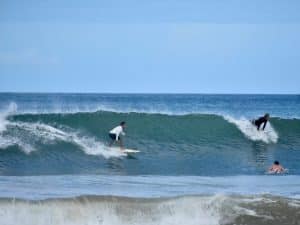
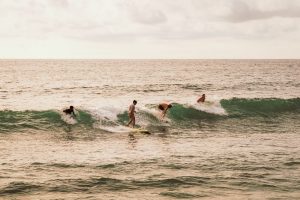
Ten minutes south of Jaco, the party town cools off and the waves get serious. Playa Hermosa is Costa Rica’s national surf stadium: a long, diagonal run of black volcanic sand that soaks up almost any south swell and turns it into powerful, hollow A-frame peaks. It is a designated World Surfing Reserve and the step up that stronger surfers make once Jaco starts to feel small, all heavy sandbar barrels and real consequence. It is not a beginner wave, and I would not pretend otherwise, but for confident surfers it is one of the most consistent and rewarding beach breaks in the country. This is a heavyweight stop on our guide to surfing in Costa Rica. Here’s every peak, when to go, and how to set up your trip.
Quick surf guide to Playa Hermosa
- Best season: green season (May to November) for the biggest, most powerful swell; peaks July to October
- Best for improvers stepping up: Backyards, La Curva
- Best for advanced: Almendros, Tulin
- Wave type: a powerful black-sand beach break with peaks all down the strand
- Water temp: 27 to 30°C, boardshorts and a rashguard, no wetsuit
- Crowds: uncrowded for its quality, busiest near the hotels
- Getting there: San Jose (SJO), about 1.5 hours; 10 minutes south of Jaco
- Budget: $60 to $120 a day
Where to surf at Playa Hermosa
Hermosa is one long beach with a string of named peaks that get progressively heavier as you head south toward the Tulin rivermouth. Tap a marker to preview a break, then click its name to jump to my full rundown below.
Terrazas
At the northern end by the hotels, Terrazas is the most-surfed peak on the beach simply because it is the easiest to reach. It throws up punchy lefts and the odd right, and it is a fine place to gauge the size before you commit further down the strand. There is submerged rock about, worst at high tide, so mind your feet and treat it with the same respect as the rest of Hermosa.
Backyards
Backyards is the reliable one, the peak I would check first, breaking both left and right off a sandbar that holds shape most of the year. It is the best all-round wave on the beach for a confident surfer, punchy and hollow without being suicidal, and it works on almost any swell with a bit of west in it. Avoid the low tide when it gets shallow and dumpy, and you will find some of the most fun barrels of your trip here.
Almendros
In the middle of the beach, Almendros is a steeper, more performance-oriented A-frame that stands up tall and rippable when the swell is in the head-high to well-overhead range. Push much past that and, like the whole beach, it starts to close out. It is a proper advanced wave with power and shape, and because it sits in the middle of the strand the crowd spreads out nicely. My pick when I want to actually turn rather than just survive.
La Curva
Toward the southern end, La Curva serves hollow lefts and rights, with the rights usually the pick, and it needs a bit of size to really switch on. It is a favorite of the local crew, so turn up humble and take your turn. The sand bottom is forgiving compared to a reef, but the power here is real, so it still commands respect. A great wave on a solid, clean day.
Tulin
At the far south end, the Rio Tulin rivermouth shapes the sand into wedging, Hossegor-style peaks that barrel both ways on a good low tide. It is the heaviest, hollowest wave on the beach and, when the banks line up, one of the best. Two warnings: it is strictly for advanced surfers, and the rivermouth is a crocodile zone, so keep out of the river channel and never surf right on top of it. Go early, the word travels fast.
When to surf Playa Hermosa
Dry season (smaller, cleaner, less power)
Wettest (November)
Hermosa is at its best in the green season, roughly May to November, when the southern swell channel switches on and sends the biggest, most powerful surf straight into the beach. This is prime time for advanced surfers chasing overhead barrels, especially from July to October, though it is also the rainy season, so surf the clean mornings before the afternoon storms. The reserve genuinely comes alive in these months.
The dry season, December to April, is the shoulder here: the swell backs off to smaller west and north pulses, the waves lose some of their heft and there are fewer closeouts, which actually makes it a more manageable time to sample the beach if you are an improver stepping up from Jaco. Tulin can still barrel on the right day. Whatever the month, Hermosa is one of the most consistent breaks in the country, so you will rarely find it flat.
Surf camps, schools and where to stay at Playa Hermosa
Because Hermosa is a powerful wave, it is more of a place to base a surf-focused trip than to take your first lesson. You can stay right on the beach at one of the low-key surf hotels fronting the peaks, which is my preference for dawn patrols, or base yourself ten minutes north in Jaco for more restaurants, nightlife and the beginner-friendly bay. If you are still learning, do exactly that: find your feet on Jaco’s mellow beach break first and treat Hermosa as the goal you build toward. For my full rundown of where to base and book across the country, see our guide to the best surf camps in Costa Rica.
Compare surf camps in Costa Rica on BookSurfCamps
What to pack for Playa Hermosa
Warm water, strong sun and powerful waves are what to plan for. My Hermosa checklist:
- Boardshorts and a rashguard, no wetsuit needed in 27 to 30 degree water
- A sturdy board and a leash you trust: the peaks here snap boards, so bring something with a bit of backbone and a spare leash
- Reef-safe SPF and a surf hat for the strong tropical sun
- A surf watch for the tides, which shape the sandbanks here, and see our board volume calculator to dial in the right board
Getting to Playa Hermosa
Playa Hermosa is about an hour and a half by road from San Jose airport (SJO), via the Costanera highway, and just ten minutes south of Jaco. Shared shuttles run to Jaco and a short taxi brings you the rest of the way, or you can rent a car, ideally with some clearance, which is worth it here for chasing peaks up and down the long beach and reaching the quieter southern end. If you are still learning, base in Jaco and its gentle bay just up the road, then graduate to Hermosa. For a wider trip, pair this with surfing in Costa Rica.
Frequently asked questions
Is Playa Hermosa good for beginner surfers?
No, not really. Playa Hermosa is a powerful, hollow beach break for confident intermediate and advanced surfers. Beginners should learn ten minutes north on Jaco’s gentle bay and only paddle out at Hermosa once they can handle fast, powerful waves and strong rips.
When is the best time to surf Playa Hermosa?
The green season, May to November, is prime, when the southern swell delivers the biggest and most powerful surf, peaking July to October. The dry season, December to April, is smaller and less heavy, which can suit improvers stepping up. It is consistent year-round.
What is the best surf spot at Playa Hermosa?
Backyards is the most reliable all-round peak, with A-frame barrels most of the year. Almendros is the steeper, more rippable wave for advanced surfers, and Tulin at the southern rivermouth is the heaviest and hollowest when the banks line up at low tide.
Do I need a wetsuit to surf Playa Hermosa?
No. The water is a warm 27 to 30 degrees Celsius year-round, so boardshorts and a rashguard are all you need. Bring reef-safe sunscreen and a surf hat for the strong sun, and a sturdy board, since the powerful peaks here can snap them.
How crowded is surfing at Playa Hermosa?
It is surprisingly uncrowded for its quality, because the waves are intimidating and the peaks spread surfers out along a long beach. Terrazas and Backyards near the hotels stay busiest, so walk down the strand toward Almendros or La Curva for more room.
Can you surf Playa Hermosa year-round?
Yes. Playa Hermosa is one of the most consistent breaks in Costa Rica and has rideable waves every month. The green season brings the biggest, heaviest surf, while the dry season is smaller and cleaner, but there is almost always a peak working somewhere on the beach.
Playa Hermosa is where Costa Rica shows its teeth: a black-sand reserve full of powerful, hollow peaks just far enough from Jaco to keep the crowds honest. Earn it in Jaco first, respect the power and the crocodiles at the rivermouth, pick your peak down the strand, and go on a clean green-season morning. See you in the lineup.